


In case you quietly filed Point Nine under “boring SaaS investor” … well, first of all, I’m not going to blame you. We’ve been investing in SaaS since 2008 and have been talking about SaaS metrics, CAC/LTV, cohort analyses, etc. ever since. We’ve always been open to swimming outside of our B2B SaaS lane, and that led us to invest in incredible companies like Revolut and Preply. But SaaS is what we were, and probably still are, known for the most.
Over the last few years, something happened though. A sizable portion of the companies we invest in these days deal not only with bits but with atoms too, so to speak (and sometimes photons, molecules, and proteins).
In the last two years, we’ve partnered with startups working on:
200-ton autonomous dump trucks for open-pit mines (Sensmore)
Personalized cancer vaccines (Serova)
Autonomous navigation for spacecraft (EraDrive)
Micro-drones that hunt mosquitoes (stealth)
A nitrogen-fixing, protein-rich crop that doesn’t exist in agriculture today (stealth)
Not your father’s SaaS portfolio. ;-)
We still invest in software, but in many cases it’s software and AI for the world outside of offices:
Hula Earth’s on-device AI identifies nearly 10,000 animal species, giving landowners a real-time picture of the biodiversity on their land.
Draxon uses VR to train airport ground handling crews.
Sereact is teaching warehouse robots to pick, place, and sort objects they’ve never seen before.
Rerun is building the data infrastructure for robotics and computer vision.
Upciti uses sensors and cameras to provide cities with real-time data to optimize operations.
(Stealth) is building the operating system for weather modification.
Where we still invest in pure software, it’s mostly foundation models or agentic systems that require extraordinarily deep domain knowledge to build, such as:
Vercept (foundation model for computer use, recently acquired by Anthropic)
Poolside (foundation model for software agents)
Forithmus (foundation models for medical imaging)
Findable (AI buiding intelligence for real estate)
Zauber (AI agents for sea and air freight forwarders)
(Stealth) (training methods for deeply superhuman coding LLMs)
A lot of these companies are working on things that could have an enormous impact on the world, using technologies that would have been impossible to build just a few years ago, which makes our jobs as early-stage investors more interesting than ever.
If we try to put them on a map (because that’s what VCs do :) ), we can see that the majority of our companies live at the intersection of “Engineered World and AI” or “Nature and AI”:
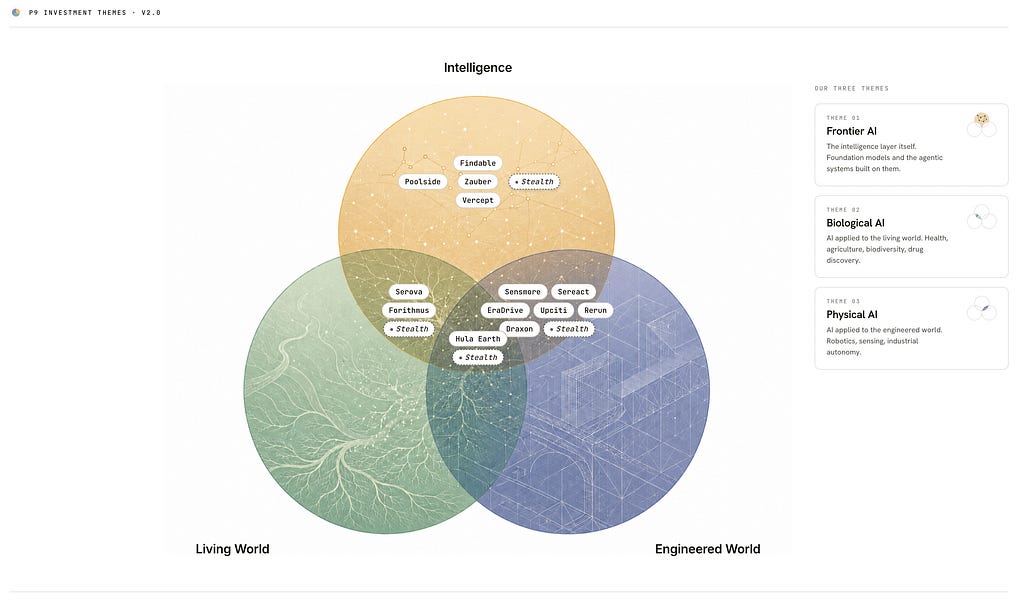
Of course there’s no perfect way to do this. You can argue some companies should be moved around a little or you can pick different dimensions … but we like this way of looking at it because it shows the three major themes we’ve been gravitating toward over the last few years.
Many of the above products are delivered as-a-service, so often it’s still a SaaS business model, albeit with different pricing, so not everything we’ve learned about SaaS has become irrelevant. But as you can see, what we’re looking for in a software company today vs. some years ago has (not surprisingly) changed quite dramatically.
2010-style SaaS investing is dead. Software investing has never been more exciting! (*)
(*) I realize this ending sounds like ChatGPT slop. I swear I wrote it myself!