


These days, deals almost always come to us through people we know. What we call “cold inbound” played a slightly bigger role in the early days of Point Nine. The best example is maybe Sascha’s 2012 cold email about the company that became Contentful, which I recently wrote about.
Today that is very rare. This post is about one of these exceptions.
Forithmus arrived as a cold LinkedIn message in mid-December 2025. I get a lot of cold messages on LinkedIn, and I have to admit that I ignore most of them because LinkedIn has become such a low-quality channel. So it’s a little miracle that I noticed this needle in the mountain-sized haystack of AI slop and investment banker outreach. (I guess I took a lesson from Clio founder Jack Newton, who likes to tell the story of how back in 2008, his co-founder Rian checked Clio’s spam folder on a whim and found two cold emails from a dubious-looking German web.de email address…)
I’m glad I spotted Ibrahim’s message. What Forithmus is building is right at the center of what I’m most excited about these days – AI applied to the digital, physical and biological world – and we’re excited that we’ve co-led Forithmus’s first round of funding, together with e2vc (an early investor in BillionToOne, the Turkish-founded diagnostics company that went public on Nasdaq last year).
From scan to draft report in seconds
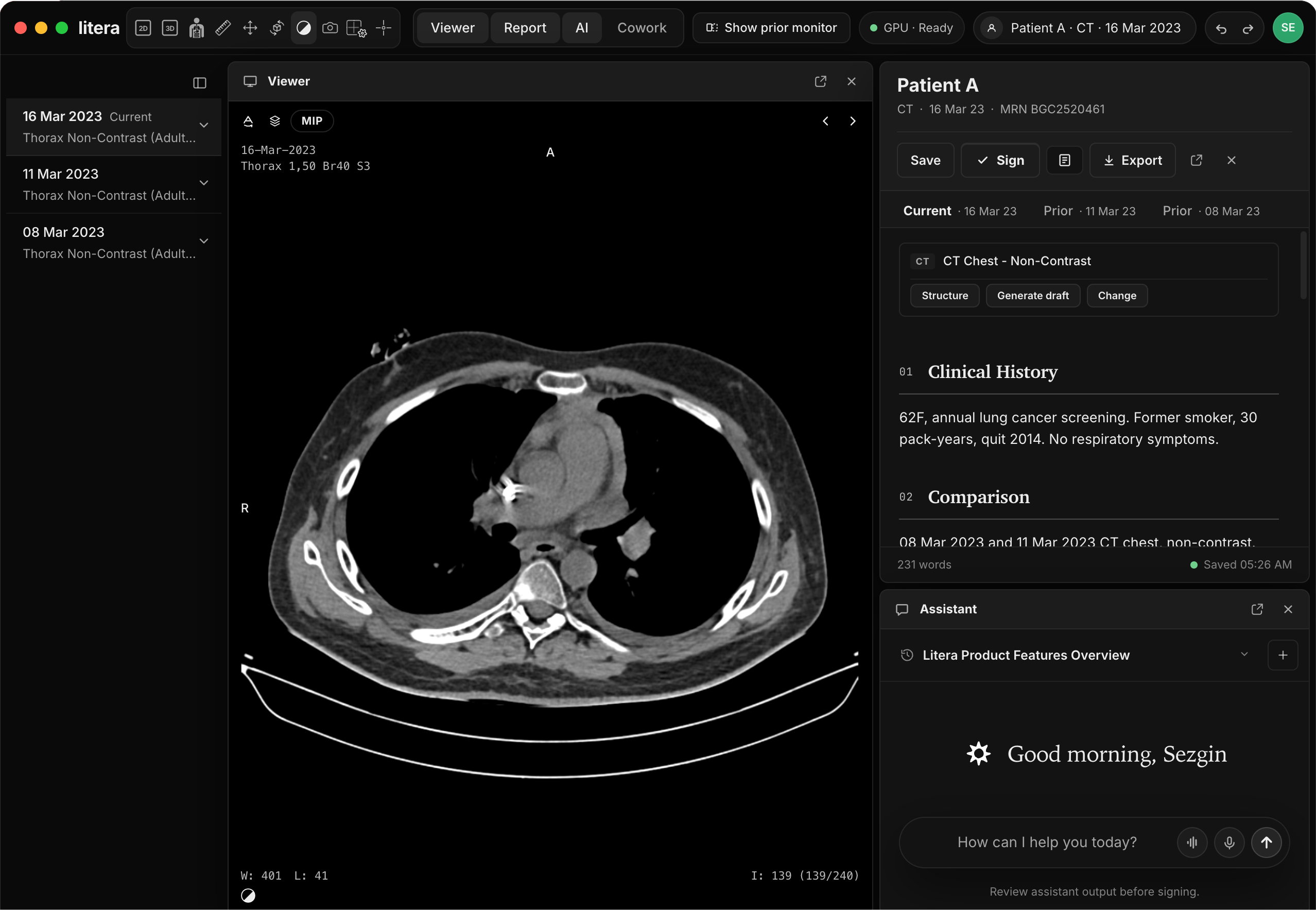
Forithmus builds AI that reads 3D medical scans (CT and MRI) and drafts the radiologist’s report. In case you’ve never had a CT or MRI scan, or only ever saw the final report: unlike an X-ray, a CT or MRI scan is not one picture. It’s a stack of hundreds of cross-sectional slices, which the radiologist “flies through” looking for anything abnormal anywhere in the body. A full-body CT can be around a thousand slices and take half an hour to read and report. MRI is typically several hundred images.
Forithmus trains models end to end on these scans, paired with the reports that radiologists have written for them. The model goes from the raw 3D scan straight to a full draft report, in seconds — what it found, where, how severe, what to do next. A radiologist I spoke to during our due diligence told me that they’re chronically overworked, and they’re always happy when a junior doctor writes the first draft of a report. But a lot of the time, there is no junior doctor available. This is exactly what Forithmus does, for every scan and at any hour.
But it’s not only about making radiologists’ lives easier. There’s a global shortage of radiologists. In the UK, for example, the Royal College of Radiologists reports a 29% shortfall of radiologists, projected to grow to 39% by 2029. In England alone, 976,000 scans waited more than a month for a report in 2024. Delays like these cost lives: a large BMJ meta-analysis found that every four-week delay in cancer treatment increases mortality risk by 6–13%, and there are documented cases of patients dying because their scans sat unreported for too long. Faster, better reporting means faster, better diagnosis — and with many conditions, that ultimately saves lives.
Hinton was half-right
Geoff Hinton, the Nobel Prize-winning godfather of AI, famously said in 2016 that people should stop training radiologists, because within five years AI would outperform them. That didn’t happen. Almost a decade later, AI in radiology has been somewhat of a disappointment. On narrow image-classification tasks, AI has become extremely good. And yet, radiologists are as overworked as ever. A key reason is that most medical imaging AI could only answer a set of narrow questions:
Is this particular tumor present?
Is there a pulmonary embolism?
Is the liver enlarged?
A model can answer one of these questions accurately and still perform only a small fraction of the radiologist’s job. The radiologist faces an open-ended problem. They must recognize a vast range of potential abnormalities, identify incidental findings, understand how anatomical structures relate to one another, and synthesize everything into a coherent report. Generating that report is much harder than classifying one finding.
In early evaluations, Forithmus reduced median reporting time by 65%. Radiologists accepted 84% of drafts with only minor edits.
What Forithmus does differently
Forithmus does a few things differently:
They train in 3D. Earlier models trained on 2D images: a single slice or a flat X-ray. Forithmus trains on the full 3D volume, i.e., the whole stack of slices, including different contrast phases (the same anatomy imaged at different time points before and after contrast administration), the way a radiologist reads it. Training on these “movies” of the body was computationally infeasible just a few years ago.
They generate the whole report. In contrast to players that answer specific questions only, Forithmus goes from the scan to the finished report, which also has to catch incidental findings (problems the scan wasn’t ordered to look for) and describe both normal and abnormal findings.
Training a report-writing model takes report-paired scans at scale, and that data is hard to get. Before raising their first dollar, Ibrahim and Sezgin assembled what we believe is the largest paired dataset of chest CT scans and reports. They managed to get enough of this data to get going, and now they’re building a flywheel that keeps improving with every report that gets accepted or edited by a radiologist.
Data quality and scale, plus a lot of domain expertise (both Ibrahim and Sezgin are both medical doctors and AI researchers who have studied computer science) and hard-won engineering in how you train on full 3D volumes, are the key to generating a reliable report across those thousands of possible findings. But the product around the model matters, too. Selling to the healthcare sector and getting new software adopted by doctors is notoriously difficult, and a tool like Forithmus lives or dies by how smoothly it fits into the radiologist’s existing workflow.
Forithmus put a lot of thought into this: radiologists can sign up and start on their own, without a months-long IT project; the product integrates with virtually any EHR or PACS (Picture Archiving and Communication System, used in radiology to securely store and manage digital medical images) in seconds; and it acts as an intelligent reporting layer that brings together report generation, dictation, guideline retrieval, segmentation, and other tools a radiologist needs in one place. It also makes reporting available anywhere, on any device, from a hospital workstation to a personal laptop or iPad.
“Don’t try to sell to hospitals”
The obvious risk is that even if everything makes sense, it can just be hard to sell into hospitals. Sales cycles are notoriously slow, and incumbents have the relationships. Every expert we spoke to flagged distribution as the concern. But I also came to realize a while ago that there are so many scars in healthcare software that if you do expert calls on anything in healthcare, you’ll always walk away thinking you shouldn’t invest. ;-)
A couple of reasons why we’re confident:
With Forithmus, the doctor, not the software, makes the call and signs the report. That makes it a productivity tool rather than an autonomous diagnostic device, which is a much lighter regulatory path.
The first hospital rollouts are underway, but in parallel there’s a bottoms-up adoption path: individual radiologists can simply sign up and start using it.
The return is concrete: a good draft does what an overworked junior doctor would do on a first pass, probably at higher accuracy, at a fraction of the cost.
Besides the specific product and distribution angle, what makes us so excited about Forithmus is the team. What Ibrahim and Sezgin accomplished before raising the first dollar is really remarkable. Their resourcefulness and determination make us confident that whatever obstacles they’ll face (and there will be plenty, for sure), they’ll find a way to remove them.
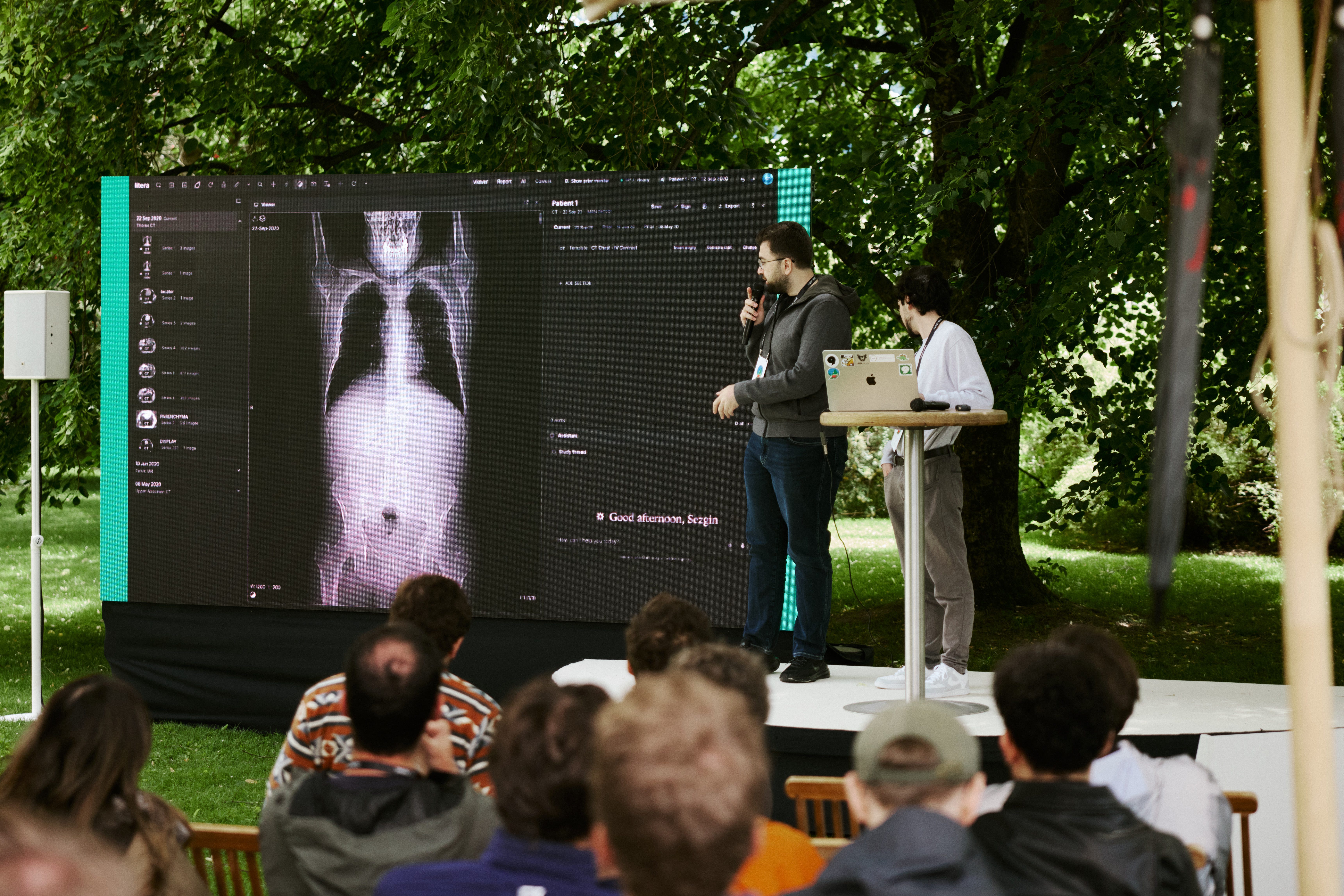
Once again, welcome to Point Nine, Ibrahim and Sezgin! If you’re a radiologist and want to try it, reach out — I’m happy to connect you with Ibrahim and Sezgin, or you can find them at forithmus.com.