


Sorry, some fine print upfront, skip at your peril : ). The following is a simplified and selective overview of complicated legal matters that cannot replace proper legal advice. If this post inspires you to take action, do check with a specialized lawyer first! We’d like to be super-experts in everything venture capital, but must — grudgingly — admit we’re falling short…
Germany has always had a complicated relationship with share-based employee incentivization. For lack of (easily feasible) alternatives most start-ups have resorted to contract-based virtual schemes which merely simulate a traditional equity-based incentive plan(1). Such a scheme is easy to implement and avoids taxation before there are actual proceeds, but comes at a huge cost: The proceeds are taxed at the full income tax rate (currently up to about 47.5%).
The problem
The obstacles faced by German companies trying to achieve the privileged taxation awarded to shares are manifold and substantial:
The beneficiary (employee) must receive real securities to “lock in” a base line above which (favourable) capital gains tax (CGT) applies. German tax law does not recognise the “derivative” most used in other countries for this purpose, the stock option, as a tax-relevant event before it is exercised.
Granting shares triggers an immediate (income) tax liability unless the beneficiary pays a purchase price at fair market value (FMV). Structures around this, e.g. a negative liquidation preference, are complex to implement and at best suitable for a few high-level recipients.
Transferring shares (instead of an option) in a German GmbH (the most common company format for SMEs in Germany) is tedious, requiring notarization and registration in the commercial register.
Share ownership in a German GmbH comes with indispensable legal rights even for micro-shareholders who otherwise have no connection to the company, in particular far-reaching information rights (sec. 51a GmbHG).
According to German corporate law some important shareholder resolutions can only be implemented promptly if they were taken unanimously — including the consent of potentially untraceable ex-employees.
Attempts to fix it
The German government tried to fix some of these issues in 2021 but the result, laid down in a new section 19a of the German income tax law (EStG), wasn’t well received. The new rule foresaw the deferral of the tax liability from the time of grant to the sale of the share (which was commendable), but only if the employee was still with the company at that point. This made the law a non-starter: If the employee left before an exit, the tax would become payable without there being any proceeds — a classic case of dry income.
With effect from January 2024 the German government sought to remedy this and certain other flaws with a comprehensive overhaul of sec. 19a EStG. These are the most important changes:
The tax liability can now be deferred beyond the departure of the employee if the employer guarantees its payment(2).
The expiry date of the deferral (which would trigger taxation even if the beneficiary is still employed with the company) has been extended from 12 to 15 years and can again be further prolonged if the employer guarantees the tax liability.
The criteria for a company to qualify for sec. 19a EStG have been generously broadened to cover even “large” SMEs: ≤1.000 employees and ≤EUR 100m revenues or ≤EUR 86m assets. It’s not a problem if a company exceeds any of these criteria at the time of allocation if they were met in one of the preceding six years (before: one year).
Securities don’t need to come from the company but may be “secondaries” transferred by an existing shareholder (although the issuer must still be the company).
BUT: The circle of potential beneficiaries remains limited to employees, making the scheme unsuitable for companies with lots of advisers and freelancers(3).
The new rules have been well-received, though some challenges remain. Yes, the dry income issue (#1 and #2 in the earlier list) has now been sufficiently addressed, but ##3–5 have not: There’s still a need to transfer real securities and there are still the minimum information rights and governance constraints if these securities are shares. For a micro-GmbH with only a few — trusted — employees this might be manageable, but once there are more than a handful of employees the admin effort, governance challenges and nuisance potential of disgruntled ex-employees continue to make a share-based plan challenging.
There are attempts at workarounds, in particular the bundling of employee stock in a company-controlled holding entity (e.g. a limited partnership in the form of a GmbH & Co. KG). Such a structure helps with governance, but also means additional admin requirements and costs. And while it may be easier to transfer shares in a partnership than in a GmbH, changes on that level will need to be reflected in some shape or form at the GmbH level. A further entity to warehouse the shares can make this easier, but creates even more complexity. In light of all this a holding setup may be the right choice for companies with adequate resources and head-office functions, but rarely for early-stage start-ups.
A workable workaround?
Could the revised sec. 19a EStG end like its predecessor and be mostly ignored? Not necessarily. A startup in Berlin, Billie GmbH, recently managed to secure a so-called payroll tax ruling (“Lohnsteuer-Anrufungsauskunft”) which confirmed that its incentive plan could be based on profit participation rights (or, shorter, participation rights — “Genussrechte”) rather than real shares. Simply spoken, participation rights give their holder the right to share in distributions and exit proceeds as if she was holding real shares, but don’t come with the information and governance rights of real shares. In essence, a participation right is not all that different from the contractual claims granted by a typical virtual incentive program.
Participation rights have always been part of the group of securities considered eligible for capital gains tax rules. But because they are, compared to shares, a fuzzy concept, it’s not easy to say at what point the package meets the label (more on this below), and a ruling of the highest German tax court (Bundesfinanzhof) hasn’t exactly made things easier. On top, participation rights can help with the German corporate law challenges, but not — until recently — with the dry income problem if they are granted below FMV.
Things look different now: The ruling of the Berlin tax authority combined with sec. 19a EStG should give Billie sufficient legal certainty. Yet its scheme cannot simply be replicated by others because the ruling is not a law and only binds the Berlin tax office vis-à-vis the applicant (Billie). One can hope that it will not contradict itself when dealing with similar cases, but there’s no certainty, and the tax authorities in other German states may not even feel a “moral” obligation to take the same view.
German start-ups shouldn’t be deterred, however. Even if a particular incentive scheme based on participation rights ultimately doesn’t find the approval of the tax authorities, it would have to be treated like a traditional virtual plan. This would mean a higher tax rate at time of payout, which would be frustrating, but not worse than what would have been the case if the traditional approach had been pursued from the beginning.
So is it even worth applying for a tax ruling like Billie did? At this point we think yes, because even if the ruling takes a year to obtain it would provide legal certainty and, if positive, allow you to be much more assertive about the tax benefits of your scheme(4). And if it turns out negative you may still be able to adjust the terms so that at least for the future the plan meets the requirements. Depending on circumstances, even a more complex structure involving a separate holding entity (see above) might still be considered at this stage.
There are two things to keep in mind: First, as of today, it is unclear whether participation rights can be issued with a hurdle price(5). Hurdle prices are common in virtual programs for allocations made after the initial funding round(s) in order to limit the award (mostly) to the value created after the allocation (making them similar to the exercise price in case of stock options). Second, the Billie plan included a small consideration to be paid by the beneficiary based on the assumption that participation rights require a financing element of about 3–5% of FMV.
It may be worthwhile including both these things in an application for a tax ruling with the aim of allowing hurdle prices and getting rid of the financing element (or at least reducing it to the one Euro-minimum German law requires for shares), but keep in mind: The more you divert from what’s traditionally considered characteristic for a participation right, the longer the process may take and the greater the risk of a rejection.
What about existing virtual plans?
What does this mean for German companies which already have a virtual plan in place? Simply converting existing virtual shares (i.e. the potential future claim they represent) and deeming the resulting participation rights to have been issued already at the time when the virtual shares were allocated will not work. The next best solution, canceling the virtual plan entirely and replacing it with participation rights, seems straightforward, but may also encounter resistance by the tax authorities(6).
This leaves one option which should definitely be unproblematic: Terminating the virtual plan for the future, i.e. locking-in a potential payout at the current value of the company, and issuing participation rights instead. If these are issued without a hurdle price the company might be obligated to pay double up to the locked-in value, however this extra benefit for the beneficiary could be reflected, even if imperfectly, by reducing the number of participation rights she receives.
A look beyond the border
Where does all this place Germany in comparison to the major VC markets, particularly the UK and the United States? Assuming the “Genussrechte-model” indeed turns out to be a workable solution, the picture is quite favourable:
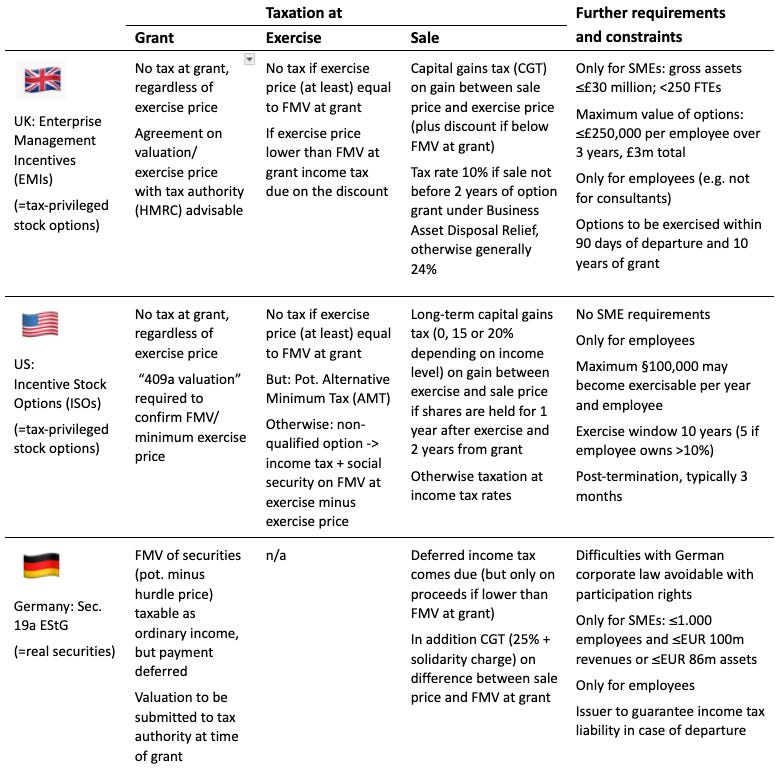
As the table shows, the UK (in case of EMIs) and US (for ISOs) get around the problem of dry income taxation at grant by treating options like real shares and requiring them to be issued with a strike price at (broadly) FMV. The exercise of the options is then effectively treated as a “non-event” and taxation only kicks in when the shares are sold.
Germany, in contrast, did not want to go as far as treating options like shares, but instead decided to allow the transfer of “real value” (= securities without a strike price) and defer the tax payment to a time when the value is realised. Assuming the Genussrechte-model is also feasible with hurdle prices, Germany’s new scheme would be more flexible than EMIs and ISOs in this respect.
Otherwise the picture is mixed: Germany’s CGT is higher than what beneficiaries in the UK and the US ultimately have to pay (currently generally 26.375% vs. 0 to 24% at most), but it does not come with the onerous exercise requirements in the UK and the US. In particular where a beneficiary leaves the company before an exit (which in today’s labor market is probably the rule rather than the exception), the need to exercise the options (and pay the exercise price) can become an insurmountable obstacle.
In terms of eligibility sec. 19a EStG is significantly more generous than EMIs in the UK, where SME criteria are tighter and the overall volume is capped. The US has no size limitations for the issuer, but ISOs are subject to a USD 100k annual cap per employee.
Time to change course?
It’s time for German startups to rethink the traditional “virtual shares default”. Even if employees may not (yet) insist on the implementation of something “better” for a while, opting for a 19a-compliant scheme as early as possible makes sense: Besides the marketing potential such a plan enables the company to achieve the same after-tax benefit for employees with a smaller number of securities than with virtual shares, meaning less dilution for shareholders. In addition the new rules are likely to become standard rather sooner than later, so the earlier you address this, the fewer beneficiaries might ask awkward questions in the future about virtual shares they got before the change. As of now, participation rights seem like the most suitable route forward, at least for smaller start-ups and despite the questions around consideration needs and hurdle prices.
__________________________
Notes: 1) The basic idea of a virtual stock incentive plan (“VSIP”, often also referred to as “VSOP”) is that certain exit events are defined which trigger a (contractual) payment to the employee depending on the proceeds payable to common shareholders and the number of virtual shares owned by the employee. 2) If an employee leaves and must return unvested (or potentially even vested) securities or if the ultimate sale of (vested) securities happens below the FMV at time of grant, the tax payment obligation is triggered, but only on the proceeds (if any) actually received by the employee. 3) In addition, only German tax subjects, i.e. employees living in Germany, can benefit from the 19a-privilege. For employees who are tax-resident outside of Germany the rules of their country, potentially modified by a double-taxation treaty with Germany, count. As of today sec. 19a EStG also requires the employee to be employed at the issuing company, however this limitation is scheduled to be removed with effect from fiscal year 2024, so that also employees of subsidiaries may benefit. 4) In addition, the FMV of the benefit issued must anyway be declared to, and confirmed by, the tax authority each time a benefit is granted. 5) Sec. 19a talks of securities being offered below market value, which is a necessary requirement for a rule that deals with deferring taxes on the implied benefit. But sec. 19a not applying (if the hurdle is set at FMV) doesn’t necessarily mean the right is no longer a participation right. If it remains one, and therefore subject to CGT rules at time of sale, sec. 19a wouldn’t even be needed. 6) The tax authority might deem the new 19a-plan an early payout of the VSIP (not in cash, but in kind, and therefore still taxable). While this seems remote (no payment was due yet on the VSIP and a tax payment obligation would undermine the deferral of the 19a-plan), there is some residual risk. Another feature that could be included in a future tax ruling.