



The Company Meeting
I’ve been a founder or early employee of several startups over 27 years, and I’ve invested and advised many more. Some were in Silicon Valley, and others are all over the world, especially those I’ve met as a Portfolio Advisor to Point Nine Capital. I geek out on why some startups succeed and why others fail to live up to their potential.
There is no set recipe for startup success, but there are patterns that cut across industries, stages, and geographies. One pattern I’ve observed is that companies that have a regular, well-run, and high-energy company meeting outperform those that don’t.
This might seem counterintuitive. We’ve all been in terrible all-hands meetings that made us feel like this:

So it is critical to run the meeting well, starting with the first principles of why startups are hard:
Recruiting. A startup can only be great if it attracts and keeps great people. Everything you do should be put through the lens of whether it helps you become a magnet for talent.
Learning. Those great people will join a company that propels their career. They want to learn as much as they can about their company, their industry, and what it takes to succeed in their role so that they can go on to take on a bigger role for you or even to start their own company.
Culture. Every great startup develops a great culture that attracts people who are a good fit for the challenges the startup faces, builds trust between team members, produces excitement and a sense of mission, and gets things done (I wrote a piece about startup culture here).
Communication. Experienced managers know that communication inside any organization is brutally hard. Even in a small startup, people quickly get disconnected from each other and from the challenge their company faces. Each team member often only sees a small departmental slice of the business, leading to poor decisions, lost opportunities, and isolation. (I wrote about transparency at startups here).
Execution. Great startups get things done. They are clear on strategy and priorities, know who is responsible for what projects, are accountable for results, and make good decisions quickly. They set a “cadence” of activities (which I wrote about here) to get decisions made and to keep moving forward.
The company meeting is a great tool because it hits on all of these challenges. The meeting is a forum for communication and learning. It’s a place for team members to hang out, build trust, and solidify culture. It can be used to welcome new recruits, celebrate successes, recognize great work, and analyze failures. It can get the team rallied, motivated, and onto the same page.
And, unlike so many things about starting a company that are out of your control, a great company meeting is totally up to you. Anyone can do it.
How to Make Your Company Meeting Great
The company meeting must be done well if you want to get the benefits. It’s a large investment — an hour out of your team’s weekly routine plus prep time. If it’s not done well it can become just another corporate ritual that wastes time and makes people cynical.
So how do you make your company meeting amazing? Here are a few things that I’ve seen work well, both at my companies and others:
Make it regular. Schedule the meeting on a set schedule, probably weekly, or at most bi-weekly. It will become part of the “operating system” of how you run your company. People will know to expect it, get good at prepping for it, and it ensures the company doesn’t go too long without connecting. Most of my companies have had a weekly meeting on Friday over lunch or in the afternoon to end the week. This creates a nice weekly cadence where you have your team meetings to kick off the week on Monday, work hard all week, then convene Friday to recap the week and celebrate before going into the weekend.
Make it employee-driven. You don’t want your company meeting to be a “management thing” where the CEO and other executives get up in front of the company and inflict whatever is on their mind onto passive employees. The meeting is community property, where anyone at the company can add an agenda item and present on a topic. You want engineers demoing new products, sales reps explaining how they won or lost a deal, finance folks sharing budget initiatives, and new hires introducing themselves.
Rotate the moderator. Let a different person moderate the meeting every week. My company asks that person do a “cold open” where they take a few minutes to introduce themselves and talk about an interesting topic, like a hobby, a cause they support, or a recent vacation. That person then introduces speakers, keeps everyone on time, and wraps up the meeting.
Bring in guest speakers. Invite a key customer to speak about their success with your product. Invite a board member to talk about why they invested in your company and what’s new in the tech industry. Invite another startup founder or CEO to give an update on how they do things at their company. People can get very heads down at a busy startup, so bring in some fresh blood to liven things up.
Give recognition and awards. My companies have usually had an employee award that is passed on from one person to another every week. The previous week’s awardee stands up, says a few words about why the next awardee is deserving, then passes it on. The cycle continues the following week. You can also add an “open mic” section to the meeting where anyone can give a shout out to a person or a team who deserves thanks and kudos.
Minimize “status reports.” Some startups default to running their meetings as a set of status reports, where the leads of sales, marketing, finance, product, etc., each stand up to give a departmental update. But status reports can get stale very quickly — people often use them to talk about internal departmental minutiae that few people care about, and they put too much focus on your org chart vs. your challenges. If you do them, keep them time-limited and keep them focused on what the team achieved and what they learned vs. just a dump of that week’s activity. Also consider doing status reports via Slack or Loom and save meeting time for something more exciting.
Focus on goals. Your company probably has a goal-setting framework, like OKRs. Any OKR worth putting people behind is worth tracking and communicating, so use company meetings to review and give updates on progress against goals, what is working, what isn’t working, and what help is needed.
Designate a note taker. People will sometimes need to miss the meeting because of vacations or key customer meetings. Designate someone as the notetaker who can write down what happened, then distribute them to the company after the meeting. You can also record the meeting if it’s done over video.
Change it up. The right format for the company meeting will change as your company grows; you’ll need something different at 100 people than you did at 10 people. Get feedback on what is and isn’t working, and keep experimenting with different formats. It’s healthy to evolve the format once or twice a year.
Sample agenda
This is a sample agenda, which is a mashup of ideas from a few recent company meetings I’ve seen:
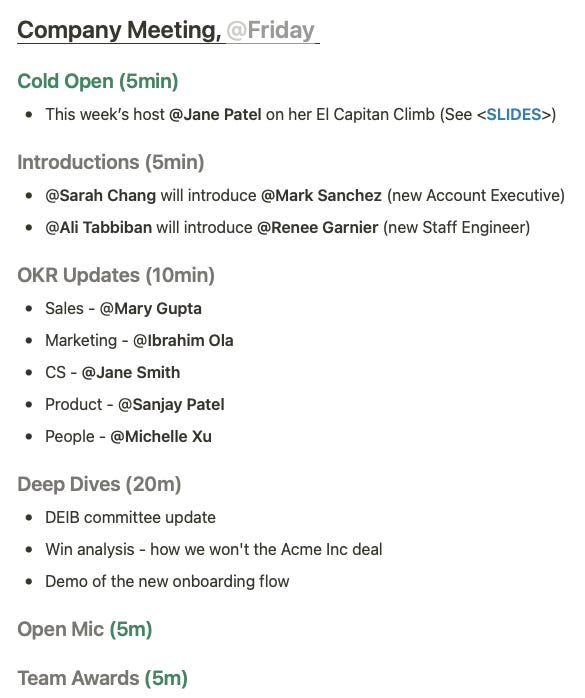
This particular agenda accomplishes a few things, which we’ll tie back to the first principles mentioned earlier:
Recruiting. New employees are introduced, which solidifies their decision to join the company. The introductions put the focus on celebrating growth, builds relationships, and reinforces what kinds of people are being added to the team.
The agenda provides several opportunities for learning. Team members get updates on what is happening, why certain decisions are being made, and learn how other functions at the company work. This gives them context for their work and gives them new tools they can use at your company or to get a promotion.
Culture is reinforced at several points. New people are recognized and welcomed. The moderator gets an opportunity to share something important to them. Team members have a forum to share thanks and kudos. You get to highlight accomplishments and behaviors that represent your culture well.
The agenda supports communication. The meeting, along with the notes taken and shared after the meeting, help communicate what is going at the startup. People hear the news directly from the people doing the work, not filtered through the management team.
Execution is emphasized through a focus on accomplishments, OKRs, key projects, and sharing learnings that will lead to better decisions. Everyone should walk away a bit smarter and a bit more capable.
And, when done well, a company meeting can be plain fun. In person, it can be done over drinks or lunch. Even if it’s done on Zoom, it’s a forum for jokes, stories, and just plain enjoying each other’s company.
But this is just a sample — you’ll have to find a structure and a cadence that works for you. But do make the investment — once you get it right you’ll be amazed at the results.
Good luck!