


Written by Savina van der Straten · First published on Point Nine Land on Medium, December 2015
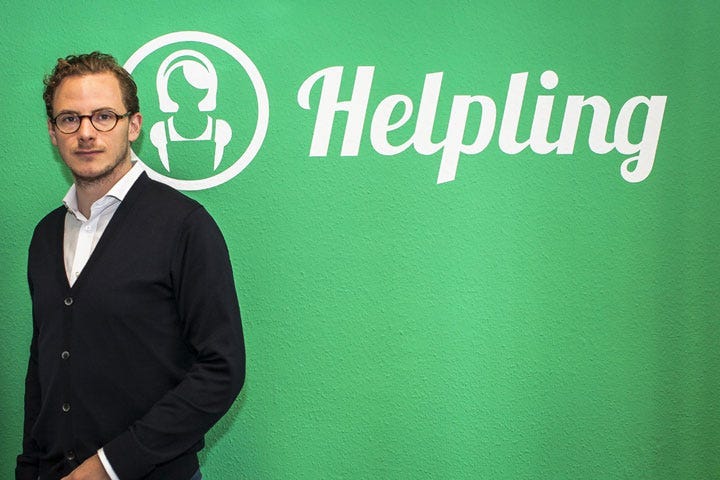
Key Facts about Helpling
Description : Online marketplace for on-demand home services.
Founded : January 2014, online End of March 2014
HQ : Berlin
Founders : Benedikt Franke & Philip Huffmann
Funding : $56,5M in 2 Rounds from 6 Investors
The on-demand cleaning service market place is quite noisy. How do you manage to stay on top of the game?
Our biggest competitor is the black market. Helpling offers a solution that leaves no reason for cleaners and their clients to get together on that broken market. We achieve that through offering a competitive price with many additional advantages: liability and accident insurance, customer service, easy time and order management and substitutes if either client or provider cancel, all online.
Naturally, we also compete with other platforms for household-related services, but as the market leader in all operating countries, we are able to provide the highest availability. In turn, this allows customers the greatest opportunity to fulfil their needs.
In addition to this, Helpling benefits from the largest pool of providers, which aids assignment and ensures stable relationships. As a result, providers are able to find the most clients that suit their requirements through Helpling. The Helpling network also gives our cleaning partners orders via nearby areas or even on the same street.
Helpling’s status as a market leader is evidenced through the provision of over 100.000 cleanings and an average customer rating of 4.8/5 for those providers mediated through the platform.
A big competitor in this market is U.S.-based Handy. Do you think there is room for multiple winners or only one global winner?
We are the Market leader in Europe, Handy leads the market in the U.S. and shows that the business model can be successful. We are both working on a tremendous opportunity to bring services online. Exploring the opportunities in our core markets remains our strong focus. In Germany alone every third person would consider hiring a cleaner. So I rather see us as working on a similar mission and shifting the mindset of an entire industry together.
You recently acquired Hassle. Do you see M&A as a natural step for growth? What would you recommend to Startup founders?
M&A can be a beneficial part of your growth strategy — especially when entering a new market — and we’re definitely opportunistic about it. With Hassle.com, it just made sense. But our focus is clearly on organic growth and this is working very well. Once you create a network effect, you become the natural choice for both customers and providers.
Could you tell me a bit more about your experience working with Rocket Internet? What are the advantages/disadvantages? How did it influence your fundraising?
We founded Helpling at the beginning of 2014, with Rocket Internet as a partner. Rocket Internet has strong expertise in many areas. In the beginning, the cooperation consisted of operational support — for example through providing a well functioning team of developers. Today, this partnership is predominantly characterised by the exchange with numerous experts and companies of this environment. We appreciate this exchange greatly.
What is your view on the recent closing of Homejoy?
The crucial point is that Homejoy didn’t fail because of their business model. I think Handy is also proving this in the U.S.. Providing services online is one of the biggest chances of digitalization. The failure of Homejoy is not connected with our business model. If General Motors fails in the automobile industry, it doesn’t mean that BMW can’t be successful.
Without going into detail of what has already been widely discussed, we can all agree that this business model only works if you are able to maintain long-term relationships by setting the right incentives. 80% of our business is with recurring customers.
We have the unique opportunity to work on a fundamental development, as online services pose one of the greatest economic development possibilities of the digital revolution. Helpling is not the only part of the trend, but we will significantly shape the development.
What kind of trends do you see in the on-demand economy?
The usage of technology enables customers and providers to get together in the most efficient way. The intrinsic advantage of on-demand services like Helpling is the usage of technology for better resource allocation. We bring together providers and customers as easily as possible, without notable transaction costs. They normally consist of search costs, pricing, organisation expenses and contractual costs. We offer a solution for all of that, with a few clicks online. On-demand services are transferable for countless industries, so that we will find everything online sooner or later — whether a product or (household-) services.