



Since May, we’ve been rebuilding our AI infrastructure at Point Nine, changing how we store and retrieve 15 years of deals, companies, founders, meeting notes and decks, and how we work with agents day to day. The goal was a shared memory for people and agents that mostly maintains itself, so we can collaborate with agents and automate use cases on the application layer at scale. We call the result the Point Nine operating system, or P9 OS for short, and we’ve decided to share what we built in two parts.
This first part follows on from Christoph’s AI killed my SaaS and covers the infrastructure. The second part will cover the application layer and what this infrastructure enables us to do there. Big thanks to Ragnor and the Modern Relay team, who massively supported us in this rebuild.
Our previous setup and its limits
Our previous setup, which we called the AI Command Center, was Claude Code running in a terminal and connected through MCP to Notion, Slack, Attio, Gmail, Granola and Google Drive, plus Zendesk and Google Sheets through n8n. A CLAUDE.md file and a set of skills told it how to work. Asked “what do we know about company X?”, the agent queried Attio, Zendesk, Granola and Drive, worked out which records referred to the same company and people, and answered from whatever it had found in that session.
While this setup showed us how useful AI retrieval could be, we ran into four problems over time.
First, all the compute happened at retrieval time, after a question was asked. Every answer waited for the slowest system, and the agent had to match names across tools on every query: a company might be “Acme” in a Granola note title, “Acme Robotics GmbH” in Attio and only a founder’s acme.ai email address in Zendesk. It didn’t always get that right, so questions that cut across systems often came back incomplete. And true to its probabilistic nature, the model read the CLAUDE.md file and the skills a little differently on each run.
Second, much of the work in venture is forming views on companies and markets. Most of that knowledge is tacit, i.e. it has always lived in people’s heads and, more recently, in agent sessions that were gone once they ended. Agents now make it feasible to turn it into explicit knowledge and keep it current, but all we had were early experiments, such as the self-learnings the Command Center kept in Slack. They didn’t work well, weren’t shared across the team and gave people and agents no way to build on each other’s work.
Third, our data was in poor shape. Attio and Zendesk had grown into two separate CRMs, both full of duplicate and outdated records, and there was no unique identifier linking what sat in Granola, Drive and Slack to the deal or company it was about. The agent flagged inconsistent data more often than not when answering questions.
Finally, the Command Center grew around Christoph’s experiments. Each one bolted on another tool, skill or script, until it became something of a Frankenstein’s monster: it worked, but only Christoph knew how the parts fit together, so nobody else on the team could really contribute. It had no memory for individual users, what it did remember sat on one laptop, it could only be reached from a terminal, and scheduled jobs failed without anyone noticing.
The design choices behind the rebuild
We made four fundamental design choices along the way based on those problems.
Pre-retrieval compute
The Command Center did all of its work after a question was asked, which meant finding the records, matching names across tools and working out what belonged together. In P9 OS, we apply the idea of pre-retrieval compute and move that work to the moment the data arrives.
“More compute spent ahead of time is less compute spent at read time.”
— Ragnor Comerford, co-founder & CEO of Modern Relay
In practice, that meant agreeing on an ontology that fits the way we work before loading any data, and having ETL pipelines match, link and embed every record once, as it comes in. By the time someone asks a question, answering it is mostly a matter of looking things up, so the model can focus its reasoning capabilities on the question instead of first sorting out the data. Take a question like “who can introduce us to X?”. We pull the relationships out of each meeting transcript once, as it comes in, and store them in a graph, so the answer is a short walk from X to the people who know it. Without that, an agent would have to read every transcript and work out who mentioned whom everytime.
Build the data model around our theses
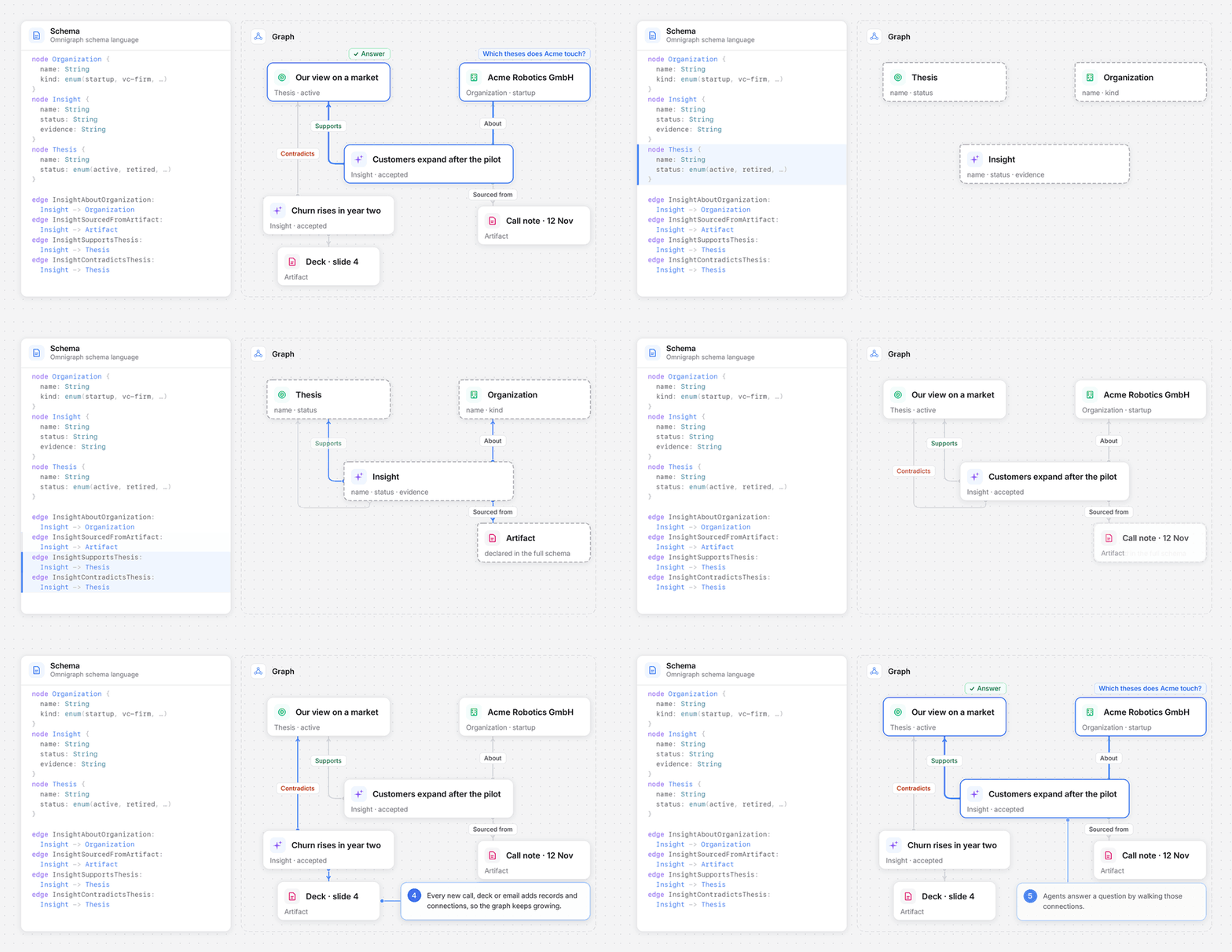
Given our thesis-driven investment approach, we form a view on a market from many small observations over time, and invest against it. Many of those observations are the kind of tacit knowledge described above, picked up in calls and conversations and rarely written down. A standard CRM schema has places for contacts, companies and pipeline stages, but none for how a view forms, so we built our data model around that process. Insights, patterns and deep dives all feed into theses, and each insight is marked as supporting a thesis, contradicting it or just adding context. With that structure, an agent can take a new company, find the theses it touches and show what we’ve already seen for and against the case. Similarly, the agent pulls what’s new out of the company’s deck or our first call and proposes it as insights on those theses and patterns, and once accepted, they add to our body of evidence on that market. So every company we look at makes the next read on that market a bit better informed.
Design for human-agent collaboration
We strongly believe that our work benefits from agents and people working closely together. Retrieval is only as good as the knowledge behind it, and a shared memory like ours only becomes and stays an accurate picture of the firm if someone keeps structuring it, updating it and resolving its contradictions. People have always had more important things to do than update their systems of record, so that work has to fall to agents. The hard part is letting agents write all the time without that memory turning into a mess (remember Karpathy’s LLM wiki ;) ).
Two things make this work: 1) the typed ontology/data schema gives every agent the same agreement on which entities exist and how they relate, so an agent can change one fact precisely instead of adding to an ever-growing pile of markdown files. And 2) each agent writes to its own branch, so one careless agent can't clutter the shared graph. The schema rejects writes that don't fit, and every commit shows who made it.
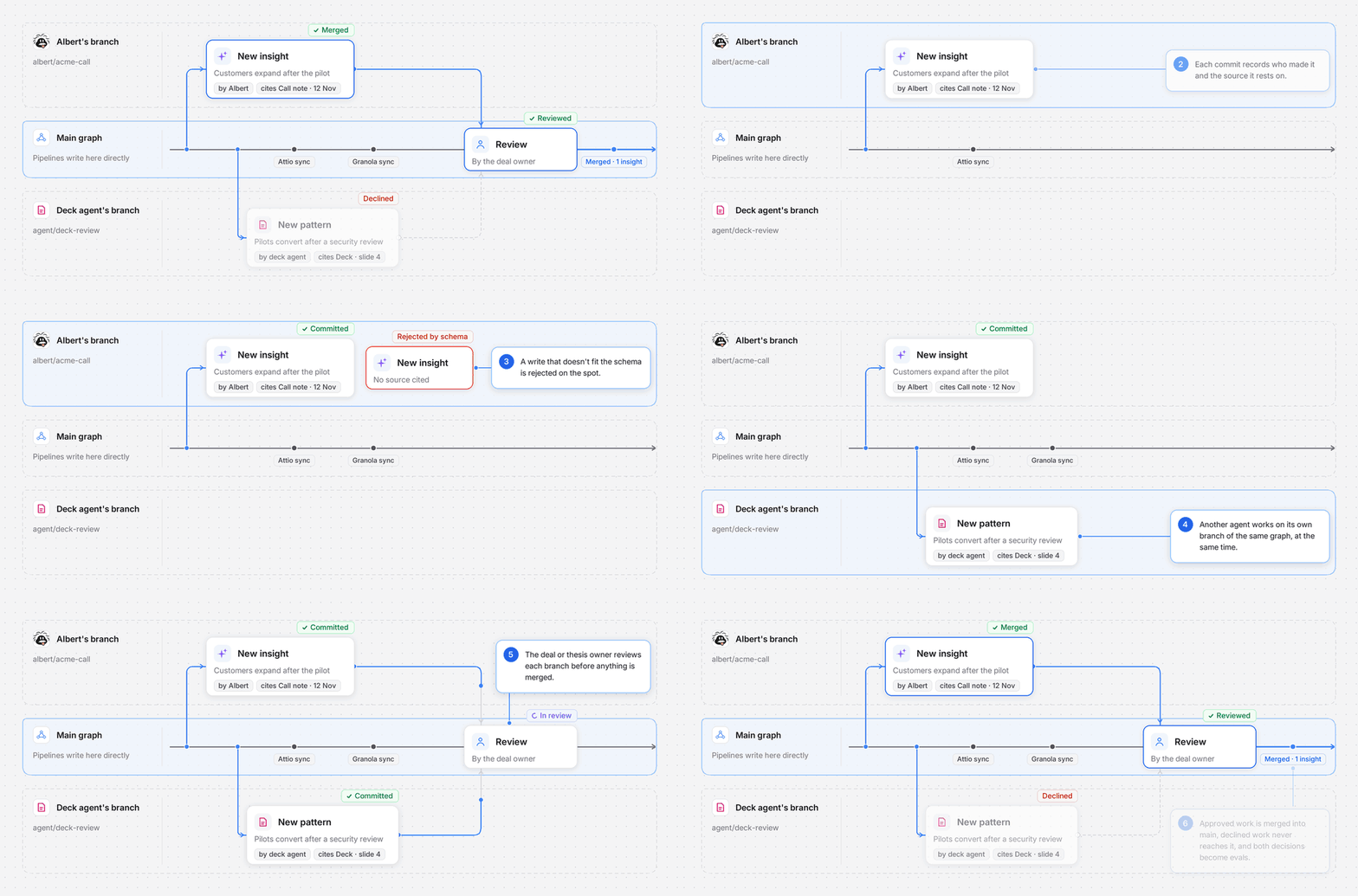
Pipelines write records and documents to the graph on their own, as long as their changes pass simple checks. For insights and other conclusions, agents read the calls, emails and documents that come in, draft entries from them and write those to a branch together with their source. A reviewer agent or human in the loop, i.e. the thesis or deal owner, then reviews the branch before anything is merged into the main graph and used across the firm.
Because every proposal ends in a merge or a decline, the reviews also give us evals of our own. We can test a new model or prompt against the decisions partners have already made before it touches the graph, and once an agent agrees with those decisions reliably, we can let it act with less review.
Make data quality non-negotiable
We hold Attio to a standard of data quality we could not keep up by hand, because retrieval is only as good as the records underneath it.
Before we connected our systems of record to the graph, we cleaned them up. In Attio we deleted about 26,000 people records, merged about 6,500 duplicates and deleted or merged about 23,700 company records. We also reconciled 40,000 Zendesk tickets with the deals in Attio and matched hundreds of Drive deal folders to the right deal. Since then, maintenance has been automated as far as we can take it, with clear cases fixed automatically and unclear ones sent to a person.
Every night, checks look for problems in the data, and a sync keeps deals consistent between Attio and Zendesk. Duplicate people and companies are merged automatically when the evidence is clear, junk records such as spam contacts and machine-generated entries are deleted, and founder profiles, companies and deals with missing details, such as a founder’s email or a company’s market, are enriched. Deal attributes like the round, the ask and the founders are pulled out of pitch decks and other materials. We also run a set of questions whose answers we know, to check that retrieval still finds them. Any lookup that comes back empty or fails is saved as a possible new test question.
What we built
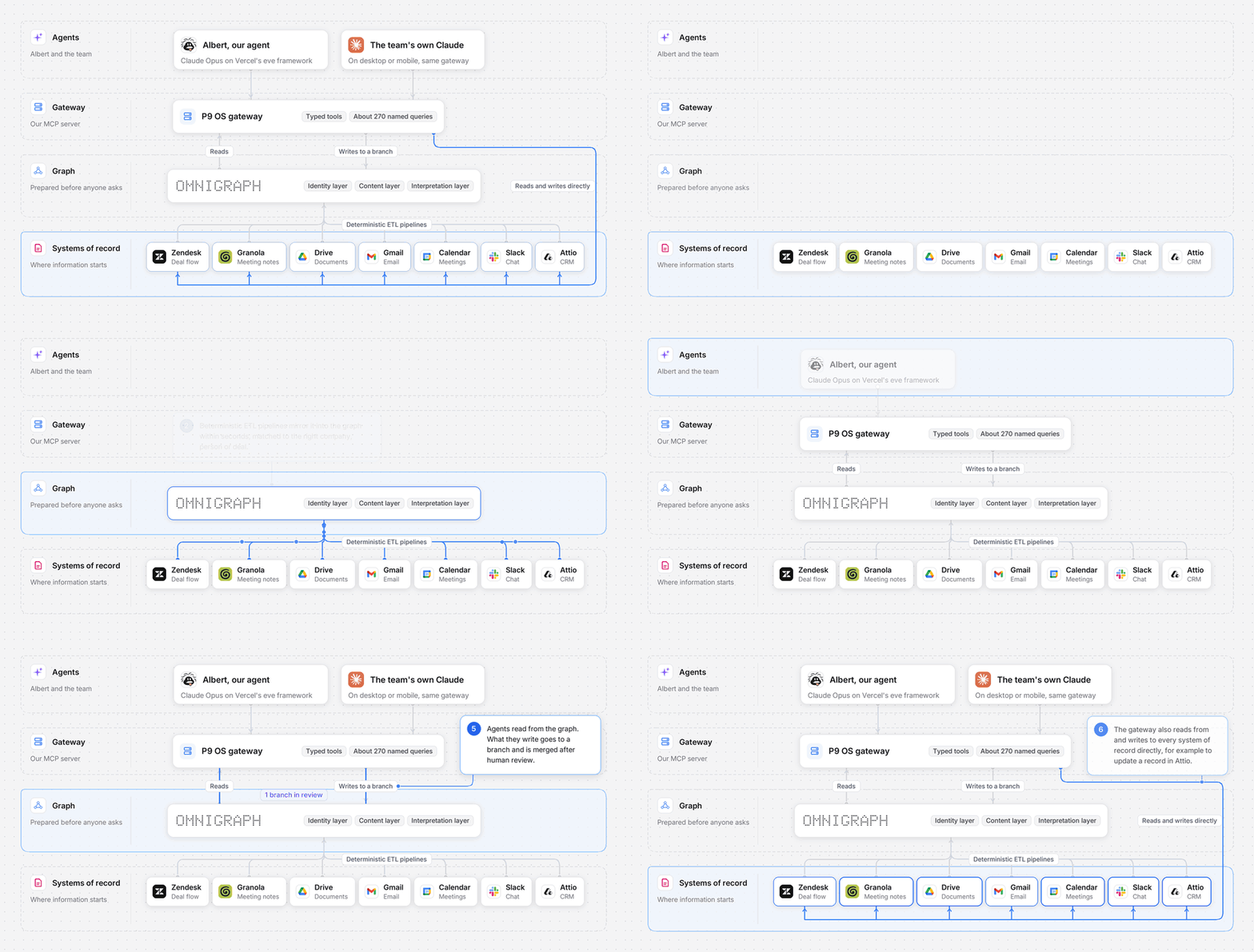
We redesigned the setup around those four decisions, and the result (of around 1000 merged PRs on Github) is the third iteration of our AI stack, called P9 OS. At its center is the Omnigraph, i.e. a retrieval substrate between the agents and our systems of record where the data is prepared before anyone asks a question. The entire stack has five parts: our systems of record, the ETL pipelines that feed the graph, the graph itself, a custom MCP server that gives agents access to it, and Albert, our agent.
Systems of record and pipelines
Information starts in our systems of record. We use Attio as our CRM and have made heavy use of its custom data objects to set up our workspace to match the core entities of the graph, i.e. people, (portfolio) companies and deals. We’re considering phasing out Zendesk, our old deal-flow inbox, and in the meantime keep a pipeline running from it into the graph. Alongside Attio and Zendesk, we use Granola for meeting notes, Google Drive for documents, Gmail and Slack.
Eight connectors and about 45 jobs now mirror everything into the graph within seconds and keep it current. On the way in, each record is matched to the company, person or deal it belongs to.
The graph
We decided to build the graph on Omnigraph, an open-source graph database built by the amazing Modern Relay team (we’re proud investors in the company). Omnigraph fits what we need in three ways: 1) our firm’s ontology is defined in code, so we can change it as our way of working changes, 2) semantic, BM25 and graph walk search all run in one engine and can be combined in a single query, and 3) its git-style versioning gives each agent its own branch to write to, which is what our setup for human-agent collaboration builds on.
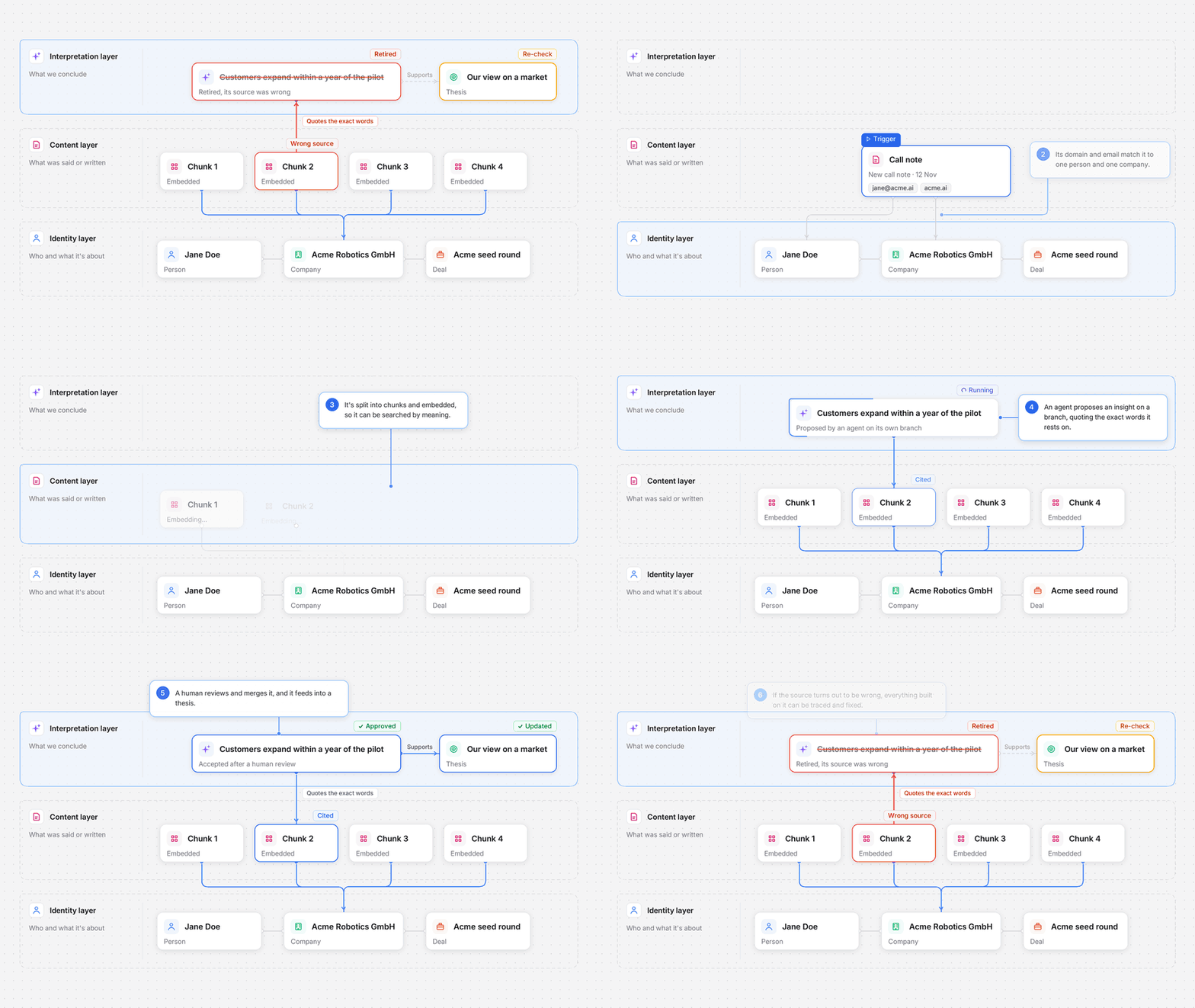
We think about the graph in three layers. At the bottom is the identity layer holding the core entities from Attio, which everything else attaches to. This layer is what solves the matching problem described above. The identifiers each record arrives with, such as a domain, an email address or a source system’s ID, all point to one company, person or deal here, so an agent no longer has to work out on every query that “Acme” and “Acme Robotics GmbH” are the same company. On top of it, the content layer holds what was said or written, such as call notes, emails, tickets, decks, memos and other Drive files. Each document is stored as text with a link to the original, then split into chunks and embedded so it can be searched.
The interpretation layer is where we record what we conclude from that content, and it’s the layer people and agents actively work on together. It holds 1) insights, which are single observations from a call, a deck or a human, 2) patterns that recur across companies and deals, 3) deep dives, our longer pieces of research and 4) investment theses, our views on a market. Every entry links back to the content it came from. We enforce that link, i.e. an insight an agent proposes is only accepted if it cites the document it came from and quotes the exact words it rests on, which makes mistakes fixable. If a source turns out to be wrong, or changes after the fact, an agent can trace every insight built on it and correct or retire those, instead of the error spreading quietly through the graph.
The MCP server
Agents reach the graph through an MCP server we built for it. The same server also reads from and writes to the systems of record, so an agent can update a record in Attio, for example. Albert uses it, and so does everyone at Point Nine who connects their own Claude to it on mobile or desktop, to look something up or change a record without switching tools. Agents are limited to the server’s typed tools and its roughly 270 named queries. Each named query is code that answers one kind of question, so that question is answered the same way every time.
Albert
Albert, our agent, runs on Opus 5.5 and is built with Vercel’s eve framework, which we’ve been very happy with. He lives in his own repo as an eve app, and everything he does is defined there in code, including about 85 tools, 16 skills, a channel for each place he works, around 30 scheduled jobs and subagents for very specific tasks. Every run is traced, and a suite of evals runs every night to test his retrieval, grounding and tone.
You can reach him wherever we already work, i.e. in email, Slack, Zendesk, Attio, Google Docs and WhatsApp. He also takes initiative, like a proactive coworker would. He runs jobs on a schedule and gets back to people when something needs their attention. Because he runs on a server, the whole team works from the same graph. For each person, he keeps a memory of how they like to work, what they’re focused on and the corrections they’ve made, and it follows them across all of these places.
Having professionalized the infrastructure underneath, i.e. one shared codebase, hosting on Vercel and permissions defined in code, means anyone on the team can extend Albert, for example by writing a custom skill or adding a tool to the MCP server.
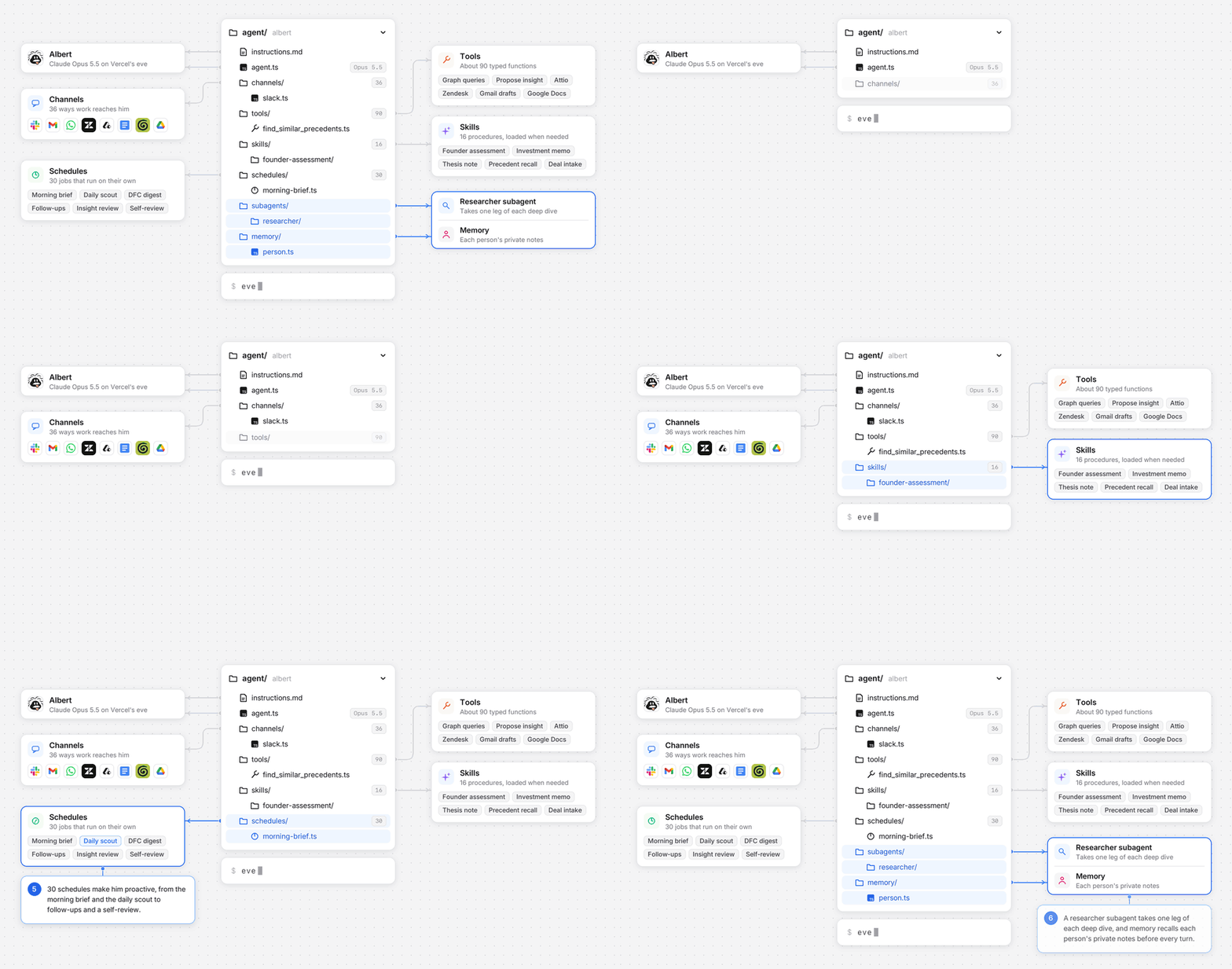
Together, this stack changes how Albert handles the example question from the Command Center section, “what do we know about company X?”, a question that cuts across all of our systems. He now reads from the graph and gets back the company and its deal history, the latest numbers we have, recent call notes and decks, and the teammate with the strongest connection to the company. He also finds precedents, so companies we’ve looked at before that compete with X or share something with it, such as the customer profile or the go-to-market approach. The precedents make use of search by meaning across everything we’ve written about past deals, and every part of the answer links to its source.
Was it worth it?
The idea of pre-retrieval compute rests on an assumption that if records are matched and linked as they arrive, an agent should find what we hold on a company faster, and with fewer wrong documents, than one that queries each system directly, as the Command Center did. We ran that test for 100 companies against our live systems looking up every document we hold on it twice: once through the graph, and once through direct connections to Attio, Granola and Zendesk. No AI model was involved in either run, so the results show retrieval alone.
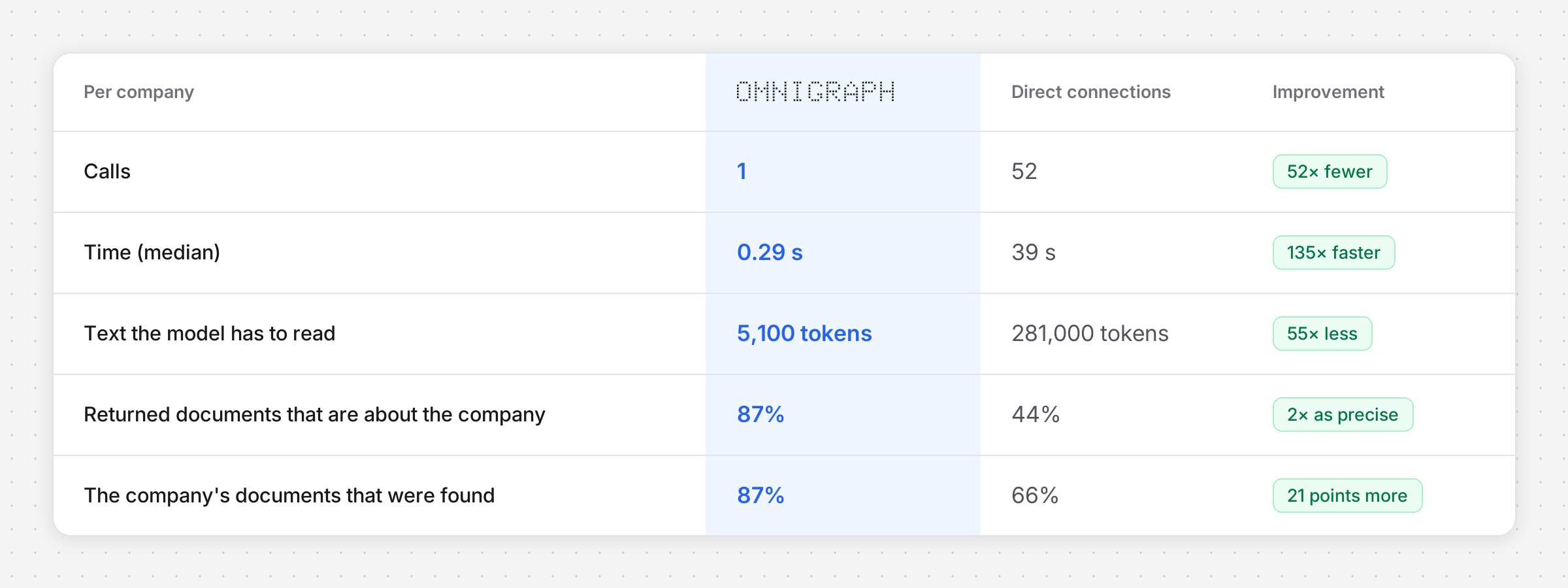
Through the graph, retrieval is more than a hundred times faster, and the results are cleaner too. Direct connections rely on keyword search, which brings back same-name companies and passing mentions along with the actual deal threads. A capable model can sort out much of that by reading everything that comes back, which is why the Command Center still did far better than a plain search engine would, but that spends the model’s intelligence, and the time and tokens in the table above, on filtering noise rather than on the question itself. The graph follows the links the pipelines made when the data came in, so twice as much of what it returns is about the company we asked for.
To avoid cherry-picking, we also timed full answers, from question to finished reply. The graph was still significantly faster and cost about half as much, but the gap was smaller, because most of the time goes into the model’s reasoning. We’re working on carrying more of the graph’s speed and precision through to that total answer time, since that’s ultimately what the team notices.
What we’re working on next
The interpretation layer is a continuing experiment. As we do more deep dives and thought experiments, and as agents see more deals and write back more insights and patterns for a human in the loop to review, we expect the way agents and people work together on it to change.
Albert isn’t our only agent. Norbert, our finance agent, already works with our ops team on portfolio KPIs, and because Vercel’s eve framework makes building agents easy, we expect to build more of them (maybe an agent for the platform team next). All of them share the same retrieval substrate, so every new agent starts out knowing what the rest of the firm knows. Over time, that probably also means bringing more finance and platform data into the graph, until it holds most of the data Point Nine works with. We also want to build better evals and make more use of our agent traces.
With the infrastructure largely in place, we’re turning our focus to the application layer to find more ways to automate the work that keeps us from the essence of what the job of an investor should be about. We’re already experimenting with custom interfaces, i.e. small apps that make it easier to share information across the team and run some of our core processes more smoothly. These mini apps are fitted closely to how we run things at Point Nine, and they’re the subject of part 2.
If you’re building something similar, or have ideas for tools or use cases we haven’t thought of, feel free to reach out to Christoph or me.
The bit that got me is the cleanup before any of it, 26,000 people records deleted and 6,500 duplicates merged, and I reckon that's the part most firms will skip and then wonder why the agent keeps getting things wrong. The rule that an insight only gets in if it quotes the exact words from its source is a really good one too, it's basically the same rule I try to hold myself to when I'm writing up raises.