


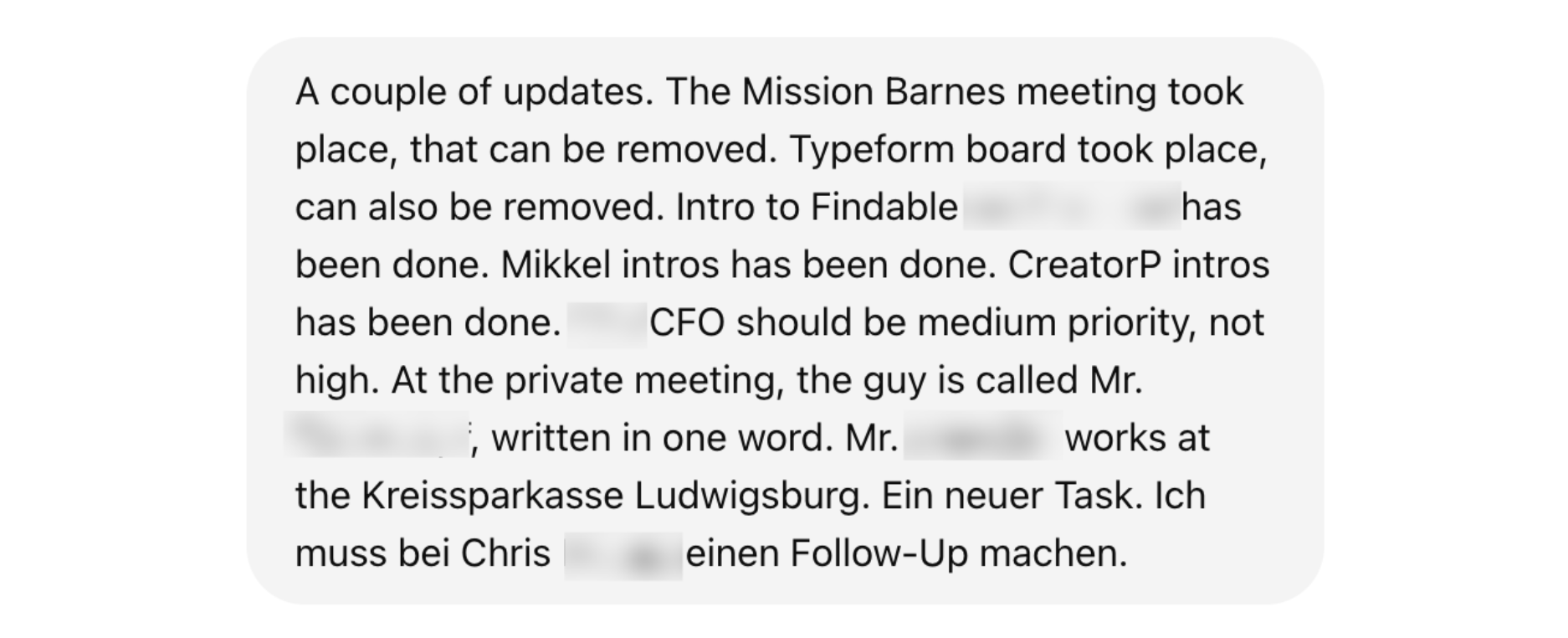
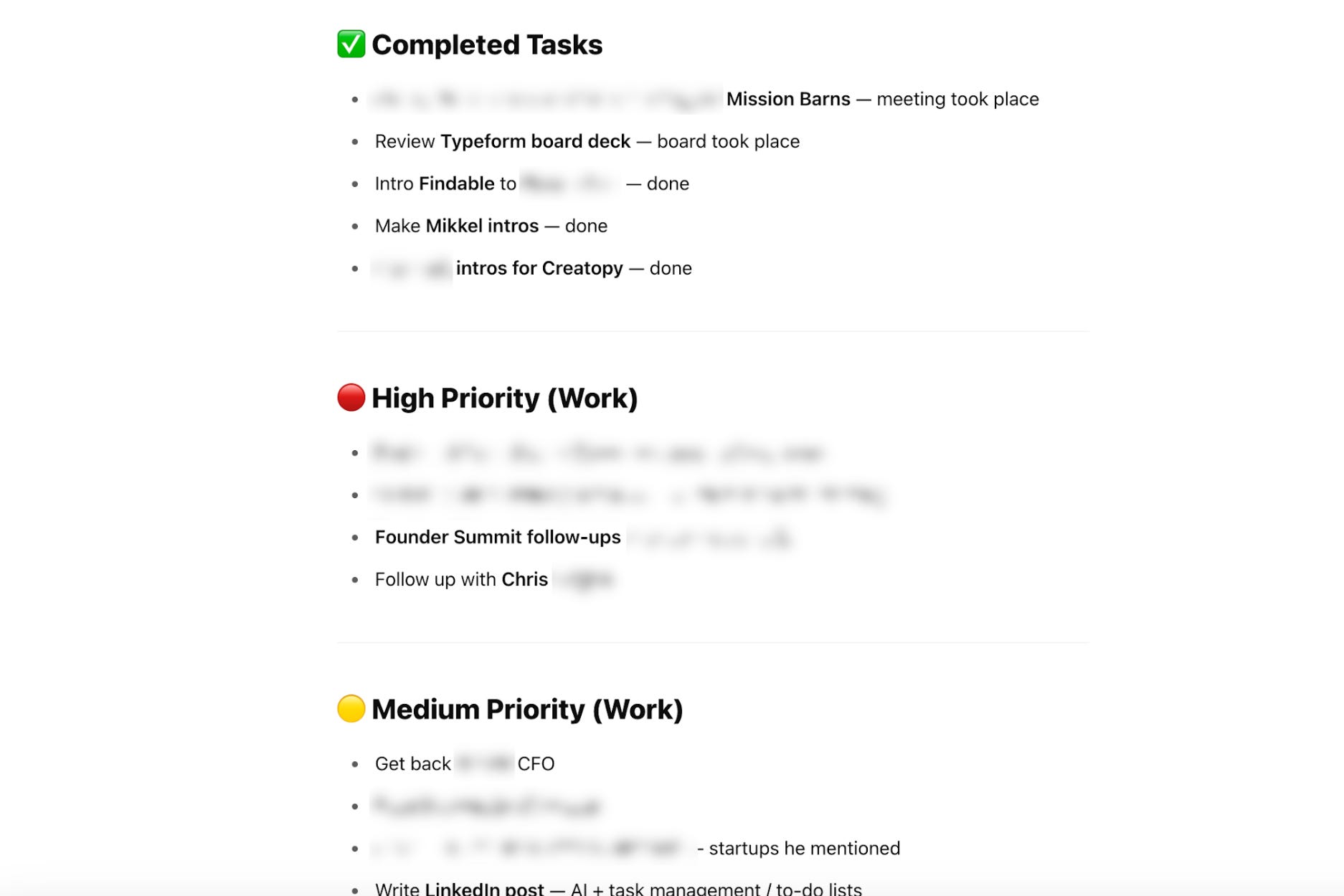
A few weeks ago, I started using ChatGPT as a to-do list app. I just dump everything that’s on my mind into it, very “raw”, usually in voice mode. ChatGPT organizes these inputs into tasks, removes completed ones, and suggests next steps. When I want to get an overview, I simply ask, and ChatGPT returns an organized list of recently finished tasks and pending tasks grouped by priority.
Here’s an example for an input …
… and how ChatGPT organizes the list:
It’s not a sophisticated setup, not even a Custom GPT. It’s just a chat in a project that I’ve pinned to the top and called “Tasks”. I just ramble every open loop in my head, usually on my way to work, and let the model sort it out.
The only customizations are an Attio export to help with name recognition and spelling and some custom instructions, but to be honest, it worked surprisingly well even before I added those. Well, maybe not surprising in early 2025 — context windows have become so long, and LLMs have improved so much in the last years — but I think my 2022 self would be surprised that a general-purpose AI could outperform dedicated to-do list apps.
Why traditional to-do list apps never worked for me
This is a bit embarrassing for someone who’s a productivity geek otherwise, but I’ve never been a great user of traditional tasks managers. I’ve tried many — it’s a busy category with a lot of great products — but none of them stuck.
One problem is that it’s hard (at least for me) to truly make the to-do list app a comprehensive “system of record” style list that includes all of my tasks. Tasks come from everywhere — email, Slack, WhatsApp, meetings. If you’re not super disciplined in consolidating everything into one place, your to-do-list app doesn’t reflect the full picture, and you end up with multiple half-complete lists.
In theory, it should only take a few clicks to copy & paste a task over, but my guess is that except for a small-ish group of GTD heroes, most people aren’t disciplined enough to do this consistently. Another option is to set up automations (e.g. using Zapier) that automatically add tasks from everywhere to your to-do-list, or forward tasks via email to a special address that then adds the task to the list. Definitely possible, but again, not so practical for most people.
Then there’s the second problem: I kept forgetting to use them (don’t laugh, I know this makes me sound stupid). And if you can’t rely on yourself checking the to-do-list app, then for an important task you send yourself an email or put a post-it on your screen, which obviously defeats the purpose.
Why ChatGPT works better (for me, for now)
Using ChatGPT as my task manager works well because:
Capture friction drops to zero. Natural language is the best UI for this type of data entry, and voice recognition is now so good that it works perfectly in voice mode.
My tasks live where my attention already is. I use ChatGPT all day, so here’s no chance I’ll “forget” about it.
The model adds (some) structure/enrichment. This will get much better with more context and integrations, but even without that, it automatically groups subtasks, suggests next steps, etc.
So far, I haven’t had problems with context drifts or hallucinations. I think after a few weeks of heavy back-and-forth, the model might lose track of what’s done, so I might have to start a new chat and copy & paste the latest status over at some point.
It’s still a bit too early to tell if I will ultimately stick to ChatGPT as my to-do-list app (I’m still in the honeymoon phase, and I’ve honeymooned with other to-do-list apps before that didn’t become lasting happy marriages). But so far so good.
Where this is going
Right now, the system is still extremely dumb compared to how it will work in 1–2 years from now (trust me on that!). ChatGPT is not yet connected to my email, WhatsApp, calendar, meeting transcriptions, Slack, files, and other systems. Connecting ChatGPT with these tools will be the real game changer because then:
It will not only track tasks, it will (at least partially) start doing them (e.g. drafting emails).
It will know when a task has been completed so it will require even less input from me for the monitoring part.
It will add/suggest tasks e.g. from meeting transcripts, Slack messages, and other sources.
It will remind/nudge me, whether it’s with a built-in reminder feature (recently introduced by OpenAI) or by putting something into my calendar.
With deeper contextual awareness, it will know which tasks are more urgent than others.
This is all very much possible with today’s AI, I just need ChatGPT to finally plug into my stack. ;-)
In the future, ChatGPT might also render a suitable graphical UI on the fly (e.g., displaying checkboxes that I can tick off by clicking). As much as natural language is excellent for task input, it’s not necessarily the best interface for every type of action.
What does this mean beyond task management?
Looking just a bit further ahead, with richer context from various data sources and greater intelligence, AI will handle more and more tasks autonomously. In many cases, users will only need to approve actions drafted or suggested by the AI.
If (and that is still an IF) AI kills traditional task managers, what does that mean for other software categories? Before you cry out “SaaS is dead” too loudly, keep in mind that task managers are very simple applications. Replacing CRMs or ERPs — with their intricate business logic, complex data structures, collaborative workflows, and permission models — is a different feat. I don’t think that AI won’t replace these within the next few years, but longer term, it’s a very real possibility (as Satya Nadella said a few months ago). And even if AI doesn’t completely replace the application, what if it replaces the UI layer? That creates big challenges, risks and questions for application-level companies, particularly those where the UI is key to their differentiation or stickiness.
As per our previous posts, vertical and highly specialized applications should have less to worry about in this scenario. Then again, there’s always the question of how fast the big players will move. Granola, Lovable, Cursor all emerged quickly in areas one would think should be dominated by large incumbents. Will the same happen in the personal productivity space and other horizontal software categories?