


Some time in October last year, a company landed in our pipeline that my partner Ricardo flagged as “fairly outside of AI :)”. As we found out, there’s actually quite a bit of AI in it — but it’s certainly not a typical software company. What Aardaia wants to do is something humans have barely done in the last few thousand years: create an entirely new agricultural crop.
My first reaction was a combination of “very interesting!” and “but food is tough…”, but after my first call with Pádraic Flood and Mike Henske, the founders of Aardaia, I posted “LAFS!!!” (short for “Love at first sight”) to our Zendesk. Fast forward a few weeks, and we led the company’s seed round.
In this post I’ll try to explain what made us so bullish about the company. But first, some background.
When I started digging in, I knew next to nothing about the seed business (despite having been a seed investor for almost two decades). My biology knowledge is limited to faint, 30-year-old memories of high-school biology and a long-standing amateur interest in evolution, shaped largely by Richard Dawkins’ fantastic books. But I greatly enjoyed learning a little about the underlying biology, and wanted to share some of what I learned.
Here’s a question … what are some new crops that have been introduced in modern history? As I learned, the list is surprisingly short. Soy is probably the best example: an ancient Asian crop that became globally relevant only in the 20th century. Everything else — wheat, rice, corn, potatoes, cassava, beans — was domesticated over centuries or millennia of patient selection.
The reason is that domesticating a new crop is incredibly slow: you typically get one generation per growing season, and each generation nudges a trait only a little. Turning a wild plant into something farmable means stacking up dozens of traits at once — yield, uniformity, taste, easy harvesting, disease resistance — and historically that took hundreds or thousands of generations.
So what Pádraic and Mike set out to do is compress something that used to take millennia into less than a decade. And they’re doing it without gene modifications.
That is the biological problem they’re trying to solve. The commercial opportunity they’re going to address is that the world, and Europe in particular, needs more, better plant protein. Demand for clean, functional plant proteins keeps climbing — the market is on track to roughly double, from around $19B today to $40B over the next decade. But every option on the market has a catch. Soy is cheap, but it’s imported and comes with flavor and sustainability baggage. Pea protein tends to taste off and doesn’t gel well. Potato protein works beautifully — white, neutral, gels great — but there isn’t much of it and it’s expensive.
It’s a global issue, but Europe feels it especially. The continent produces plenty of calories, but it still imports a large share of the high-protein plant feed used for livestock, especially soy from the Americas. That is inefficient, bad from a sustainability point of view, and increasingly a political problem, with growing pressure to produce more protein at home.
What Aardaia is building
Aardaia is domesticating the aardaker (Lathyrus tuberosus), a long-forgotten European legume that grows edible tubers. If you’ve never heard of it, same here. The closest thing in my head was “aardvark”.
The aardaker turns out to be a pretty unusual plant:
Aardaker can work with nitrogen-fixing bacteria to convert nitrogen from the air into a form the plant can use, reducing the need for synthetic fertilizer. What’s more, unlike soy, which usually has to be “inoculated” with compatible bacteria because its bacterial partners are not reliably present in European soils, aardaker’s compatible rhizobia are much more likely to already be present in local soils.
Unlike potatoes, whose tubers are mostly starch and relatively low in protein, aardaker stores significant protein directly in its tubers (around 25% of dry matter), white, bland, and strongly gelling.
It was actually grown in the Netherlands before the Industrial Revolution, then lost out to the potato.
So nature already spent hundreds of millions of years evolving a plant with more or less exactly the properties the protein market is asking for. It just never got turned into a real crop, because until recently that was impossibly slow. The thesis is that you can combine potato-like yields, soy- or pea-like protein, and potato-like starch into one new European crop.
Aardaia doesn’t introduce any foreign genes and doesn’t modify the genome using modern gene-editing techniques. It’s good old-fashioned breeding — pick the best plants, cross them, repeat — just enormously sped up. Instead of inventing new traits or trying to transfer traits from other species, they’re searching through a huge, barely touched pool of natural genetic variation for the good combinations that already exist, and putting them together.
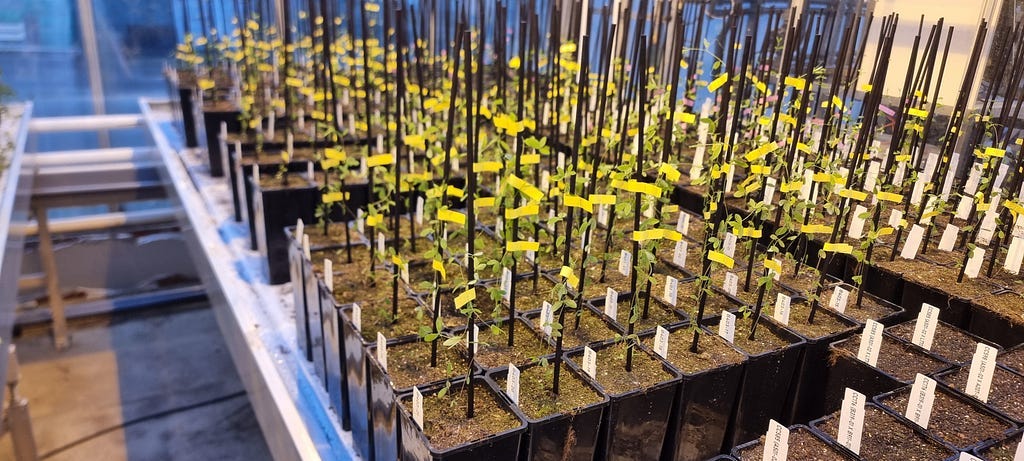
Why is that pool so rich? Crops like maize and wheat have been bred for ~10,000 years, and along the way they’ve lost most of their genetic variation. They’re close to their ceiling — squeezing another 1% of yield out of them is a big deal. The aardaker has barely been touched, so almost all of its natural variation is still sitting there, unused. Pádraic likes to point out that their greenhouse — full of wild plants collected from about 20 countries — probably holds more genetic diversity than the entire human species. (We’re all unusually similar to each other genetically, because humanity squeezed through a population bottleneck around 200,000 years ago. The aardaker never did.) More variation to play with means more room to keep improving the crop, year after year.
How it works
This is roughly how they turn all that raw variation into an actual crop, fast:
They built a high-quality, chromosome-level reference genome of one single plant (or one specific genotype, to be more precise). Every other plant they sequence gets lined up against that reference, which lets them see exactly where it differs. (Later you can blend several plants into a “pan-genome” so you’re not leaning on just one individual, but you start with a single good reference.)
Genomic prediction. They grow tens of thousands of different plants, connect DNA differences to traits (yield, protein, flavor, disease resistance), and build models that predict which crosses will produce offspring better than anything they’ve grown so far. At the seedling stage, a cheap DNA test from a leaf punch tells them which plants are worth keeping — so a lot of the selection happens on a computer before the field does the slow, expensive part. Cattle breeders, for example, have used the same statistical approach for years. What’s new is pointing the full modern toolkit at domesticating a brand-new crop — which nobody has done, and which wasn’t even affordable until 5–10 years ago, when sequencing costs fell by roughly a thousandfold.
Speed breeding. In climate-controlled chambers, they push plants to flower early. Their fastest have gone from seed to flower in about five weeks. The goal is a ~10-week seed-to-seed cycle, which would mean up to five generations a year instead of the one you’d get in a field — a 5–10x speedup of evolution itself.
Shuttle breeding. They grow in multiple hemispheres and climates at the same time (with seed orchards in the Netherlands and in Sardinia), which speeds up adaptation and shows early on how the crop behaves in different soils and weather.
Most of the world is trying the opposite approach: take an existing crop and engineer a new trait into it. The Gates-funded effort to engineer nitrogen fixation into cassava, for example, is a roughly 30-year project. Aardaia’s bet is that it’s faster and cheaper to find a plant that already has the trait you want and breed it into a crop. The aardaker already fixes nitrogen and already makes protein-rich tubers. As one plant scientist put it to me: a better crop with no fertilizer, versus the same old crop with a bit less.
Plenty of companies use genomics and modern breeding — but to improve crops we already have (a better potato, a better wheat). Almost nobody else is trying to genomically domesticate a genuinely new one. That gives Aardaia a head start — and the lead compounds, because they keep piling up proprietary plant material, a hybrid-seed system, and a genotype-to-trait dataset nobody else has.
The key questions
There are obviously still risks and unknowns.
Biology and yield. Can they get field-average yields up fast enough? Today they’re at around 4 t/ha. ~10 t/ha gets them level with potato protein, ~40 t/ha level with soy, and 50+ t/ha cheaper than soy. Their best individual plants already extrapolate to well over 30 t/ha — but a single star plant isn’t the same as a whole field’s average, and closing that gap across seasons, soils, and diseases is the hard, slow part. What makes me optimistic is that the crop’s huge untapped variation, plus the speed-breeding loop, give Aardaia far more shots on goal per year than a normal breeder gets. And the early seasons are already trending up.
Agronomy. Since the aardaker hasn’t been farmed at scale in about 150 years, the basic farming manual — spacing, ridging, fertilizer, irrigation, harvesting — has to be written almost from scratch. The good news is that these are knowable, adjustable variables, not deep scientific mysteries.
Market and adoption. Farmers won’t plant a crop with no buyers, and processors won’t commit without supply. Here the demand is already real and pulling: Aardaia sells every tuber it can grow to top restaurants today, and it’s in active talks with large European food-ingredient players. The restaurants build the brand and the story while the ingredient business gets built underneath.
This needs amazing talent, knowledge, and engineering ingenuity. But it does not need a miracle. It needs roughly an 8x improvement in yield — hard, but not the kind of 100x leap some deep-tech bets require — and it already makes money today. Aardaia sells its tubers to a celebrated two-Michelin-star plant-based restaurant in the Netherlands, where the limit is supply, not demand. Every field they plant pulls double duty: it brings in revenue, and it produces the ~100,000-plant dataset that feeds the next round of breeding.
While the near-term business is restaurants and ingredients, the long-term business is built on hybrid-seed genetics, which makes it look more like biotech, pharma — or software. When two carefully selected parent lines are crossed, the first-generation crop can have exceptional traits, but those traits do not reliably reproduce in the next generation. So the IP protection is built into the biology itself — farmers buy fresh seed every season because that is the only way to reliably get the high-performing crop.
When we talked to people who know Pádraic, the same things kept coming up: that he is one of the most impressive plant scientists of his generation; that this crop is his life’s mission; and — my favorite, that he is “pure”, someone who genuinely wants to help and means it. He did a PhD in plant genetics, spent five years at the Max Planck Institute, and was Director of Genetics at Infarm before this. Mike is the commercial and operational counterpart, bringing deep agribusiness experience. Together, they grew the aardaker program about fivefold with basically just the two of them, before raising a cent.
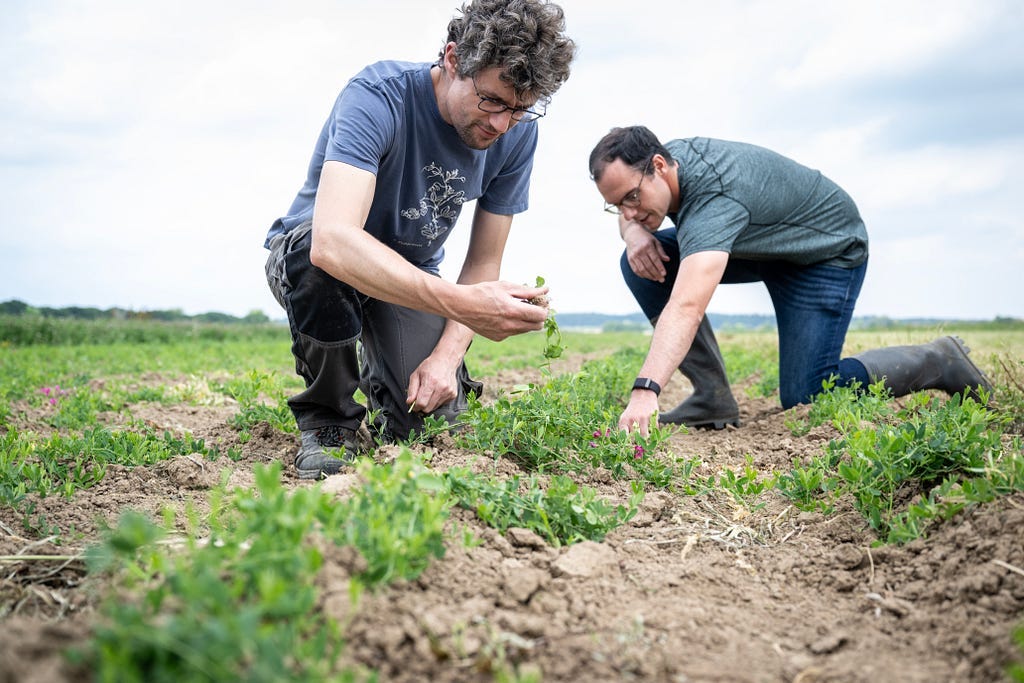
If you’ve ever wanted to work where genomics, AI, and the physical world of farming meet, Aardaia is hiring across plant breeding, computational biology and genomics, AI for breeding, agronomy, and food science … go talk to Pádraic and Mike!