


Guest post by Maddy Cross · First published on Point Nine Land on Medium, December 2022
Guest post: Hi there, it’s Maddy (again!). As a Partner at Erevena I lead the B2B Marketing practice in Europe, helping founders to hire world class marketing leaders. I also enjoy doing research to help founders make better hires and have published a few pieces like the Unicorn Trajectory and this one on Point Nine Land about what it takes to get to Series A from a hiring standpoint.
One of the (many) things I’ve been mulling over recently is the question of compensation. We so often think about compensation as a snapshot in time: what does a VP Sales cost now, what equity should I give to my CTO now, and so on. It’s of course understandable to think of it like this because we generally look for these data points right at the point that we are planning to hire someone. But, we don’t think of runway like this and we don’t think of capital raises like this, and when hiring is the number one cost for a software business, looking at how salary costs have changed (and how they might change) is key to adjusting our plans for runway or capital raising.
On top of this, the last few years have been a real roller coaster in early-stage business-land. We had the mass layoffs of early 2020 into a bullish 2021, and then back to some more layoffs now. As a result, salaries are all over the place (I think the business word for this is ‘dispersed’ but for now let’s go with ‘all over the place’).
So to get an idea of how things are looking pre and post COVID, and to hopefully shed a bit of light on where things are going as we head in 2023, I’ve spent some time stitching together the data that I could get my hands on. Let’s get into it…
The data that you’ll see in the following charts is from:
VCECS/Option Impact for 2019 and 2021
Erevena internal data points for 2019 and 2021
The Erevena 2022 Leadership Compensation Report data for 2022
Other things to note about the data:
Usable data for 2020 doesn’t exist because… COVID
Bonus/Commission data isn’t included anywhere as there isn’t enough data to be able to include it
All data is for non-founding leaders (VP, AVP, SVP, C-Suite and GM) in Europe and the UK, in B2B software businesses
I have only included data where there are at least 10 data points; everything else has been excluded — this is why equity data is for all functions combined.
Compensation for non-Founding leaders in B2B software and marketplace businesses in Europe and UK that have raised $3m-$10m
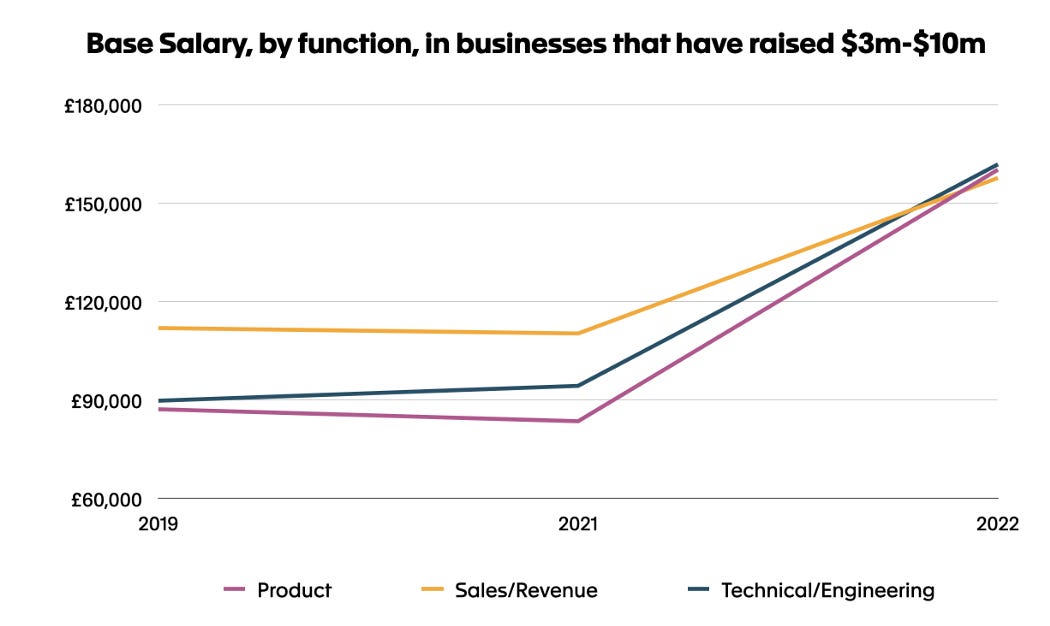
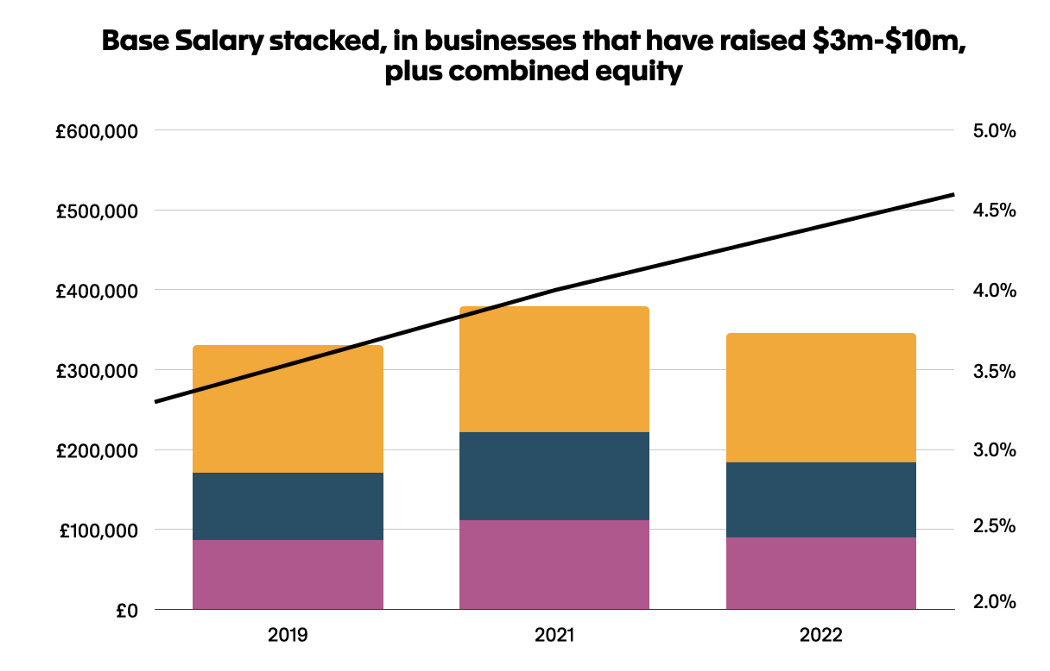
The key things to note on the above charts are:
Base salaries for all functions at Seed stage (raised $3m-$10m) are rapidly increasing, and also converging, having been very steady from 2019 to 2021
We think the huge increase between 2021 and now is because there are so few leaders with experience at this stage in comparison to demand for them, that many companies have been looking to a stage later for recruiting, as well as to the US now that hiring remotely is more possible than it was pre-COVID.
Equity in 2021 was noticeably larger in comparison to base salary — we think because people from later stage companies were taking ‘riskier’ roles in early stage businesses. In 2022, this ‘risk’ was compensated for with cash, as execs started to realise that valuations may not sustain, but in 2021 it was compensated for with equity.
Now, a leadership team of Product/Sales/Tech will cost almost £500,000 basic and 4.6% equity, at this stage.
Compensation for non-Founding leaders in B2B software and marketplace businesses in Europe and UK that have raised $10m-$25m
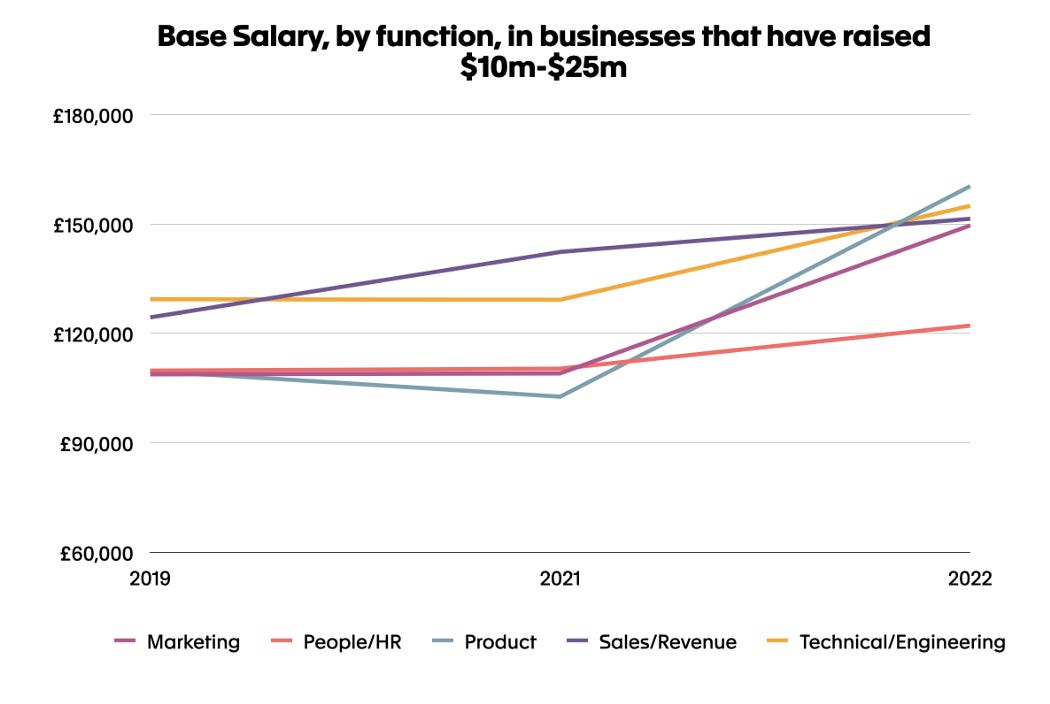
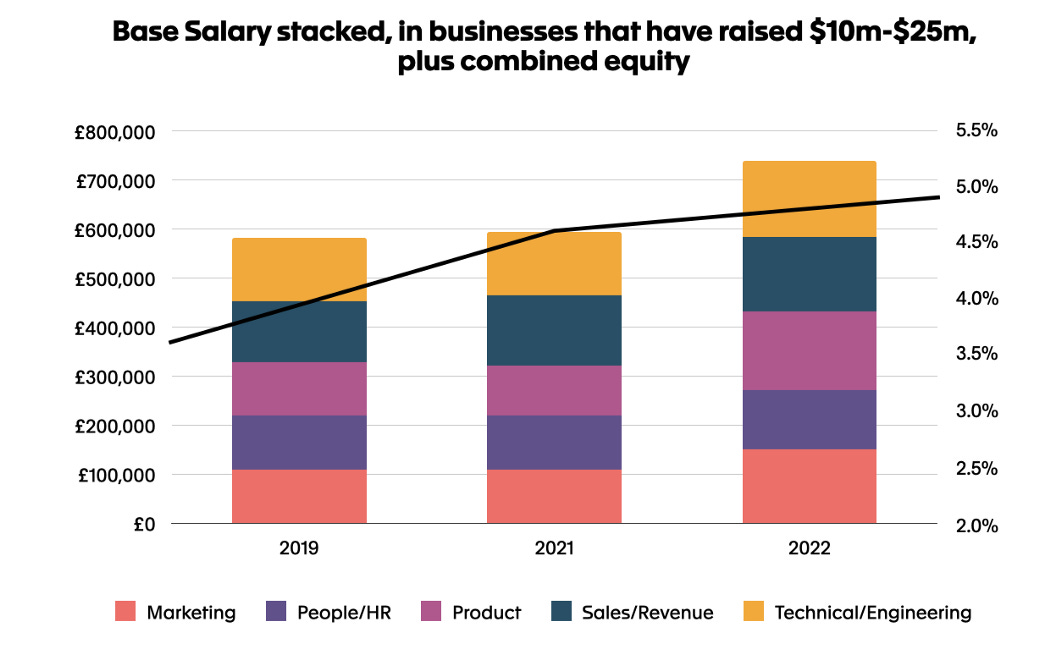
The key things to note on the above charts are:
The base salary of Sales/Revenue roles increased from 2019 to 2021, with all other functions staying static. We think that this is because, historically, sales leaders were on 50% basic/50% commission plans, but under very tough market conditions for selling and very high demand for Sales/Revenue leaders, this balance changed to around 60% basic/40% commission.
People/HR roles are still lagging, despite demand for these hires being so huge in 2021. We think this is for two reasons:
Demand was so huge that many businesses started hiring more junior ‘step up’ candidates into VP roles, who as a result were paid slightly less than their colleagues
Gender: I don’t want to wade into a conversation about gender (and believe me, I could wade into it for days) but there are a large number of data points out there that show female leaders are paid less than their male counterparts, and certainly at Erevena, we hired more women into People/HR roles than most other functions during 2021/2022.
Equity had a disproportionate jump from 2019 to 2021, but tricky to say why exactly.
A ‘full’ leadership team now at this stage will cost £750,000 in basic salary, and 4.8% equity
Looking across different stages…
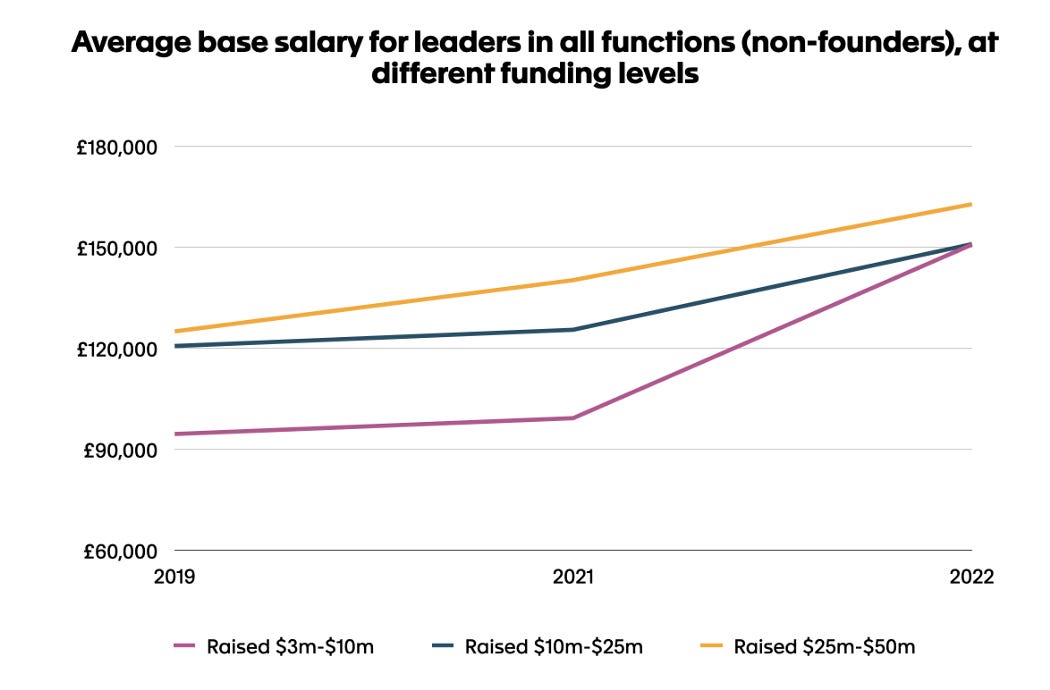
As mentioned previously, the key thing here is that leadership costs at different stages of businesses are converging, as companies start to hire leaders from later stages because of demand/supply issues making it tricky to hire from the same stage.
Looking at different countries…
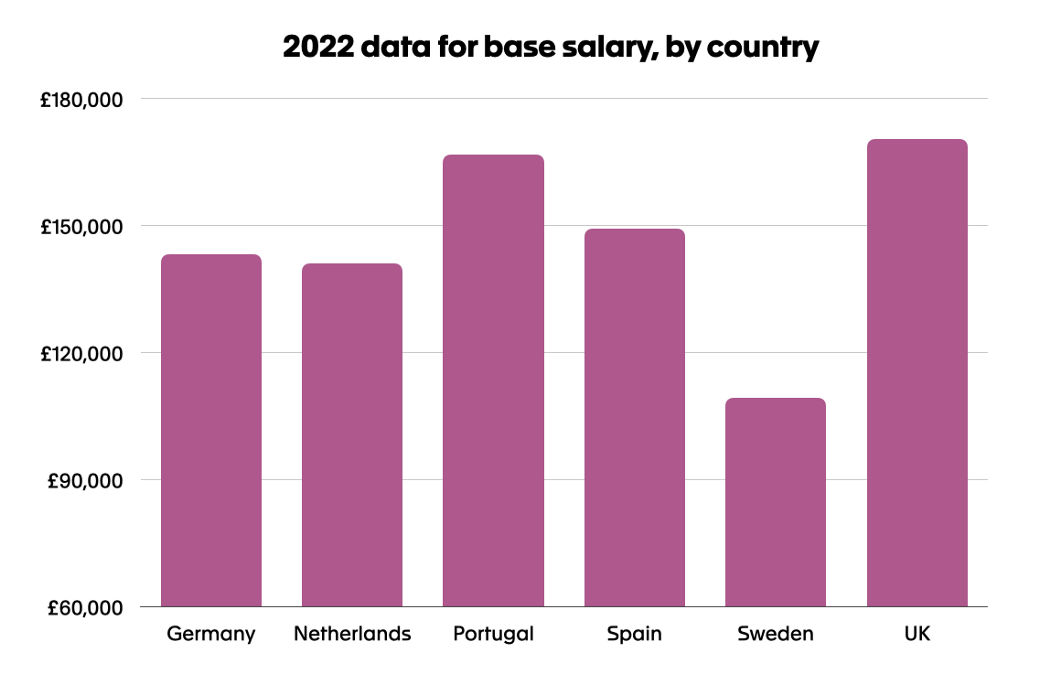
The UK is still the priciest place to hire a leadership team, and — surprisingly — Portugal takes second place. Unfortunately as the VCECS/Option Impact surveys had regional data bunched together (e.g. ‘Southern Europe’ rather than splitting it out by country), data from the Erevena survey in 2022 is the only data we can use here.
Figures HR (a Point Nine family member) have also published this very cool comparison tool, in case you’re thinking about comparing regions.
What happens in 2023?
The short answer is that it’s very hard to tell. With major tech companies making large layoffs, and fundraising slowing right down, there is a reasonable case to be made for expecting compensation trends to stay pretty level into 2023.
That said, however, with inflation on the rise, there is some merit in assuming that this will not be the case and that salaries will continue to increase, although not necessarily in a way that’s greater than inflation.
Figures HR recently polled 200+ startups to find out how they’re going to approach compensation with regards to inflation, and the key findings are that only 20% of startups said they would not be doing anything to address inflation:
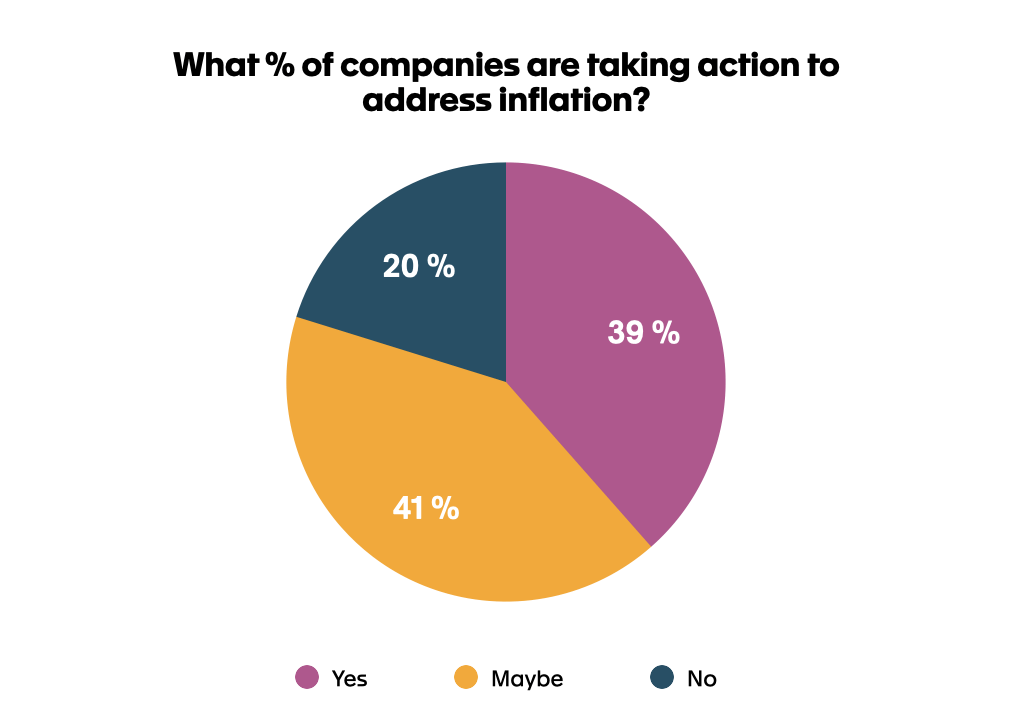
Of those that are taking action, the breakdown is as follows:
A salary increase has been done/is planned in the near future — 40%
I have reviewed/revised my salary ranges to fit the current market over the long term — 32%
A larger budget is planned for the next compensation review — 19%
We have provided/will provide a dedicated one-shot bonus — 9%
Figures HR also published this report on the topic of Salary Budgets for 2023, that notes that ‘on average, companies are planning for a 6% budget dedicated to [increasing salaries]’ — it’s definitely worth reading if you’re thinking about how to approach salary increases.
Adding further info to this is the move from the Belgian government to increase salaries by inflation, by law. Belgium isn’t the centre of start up activity in Europe, but even having a few employees there will mean — for many businesses — that they will have to increase all employee wages to keep things fair across the business.
Either way, if you’re an early stage founder starting to think about planning compensation for 2023, assume that:
The ‘average’ leadership hire will cost at least £150,000 basic plus 1–1.5% equity (plus bonus)
In the UK and Portugal these numbers will be closer to £170,000 and 1–1.5%
Don’t assume that data will stay static — only 20% of startups are not planning to raise compensation in line with inflation, so by far the majority of employers are planning increases
If you aren’t sure how to approach this or need more data…
Use Figures HR to check industry compensation benchmarks
Speak to Erevena (or other recruiters) to get a view on whether the costs you’re planning for are an accurate reflection of what candidates are expecting
And otherwise, wave goodbye to 2022 and let’s see what 2023 has in store!
PS huge thanks to Virgile Raingeard at Figures HR for thoughts and data points!